Sri Lanka Budda's Island
Click here for the Maldives Dhoni Cruise part of this trip
December 15, 2005 to January 9, 2006 (23 days) 2005/2006
This was a month-long trip in a carryon bag for $2552 USD with Explore Worldwide
http://www.explore.co.uk/
.
Sri Lanka was the first part of this trip with Adventure Center www.adventurecenter.com.
The second part of the trip
to The Maldives on a Voyages Maldives boat www.voyagesmaldives.com.
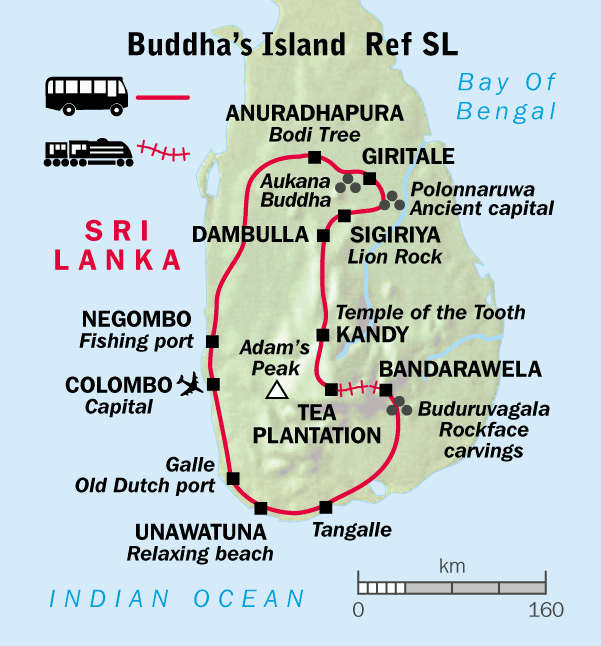
TABLE OF CONTENTS
Introduction
Travel Tips for this trip, Web Sites,
Cost, Food, Weather
About Sri Lanka, About Monks,
UNESCO Sites
About the Tsunami, Newspapers
Day 0 Getting There Depart Thursday Dec 15 Arrive Sunday Dec 18
Day 1 Sunday Dec 18. Join tour Colombo / Negombo
Day 2 Monday Dec 19 Tile Factory, Coconut Shell Processing, Toddy Tapping, Hindu Temple
Day 3 Tuesday Dec 20 In Anuradhapura; Mihintale
Day 4 Wednesday Dec 21 Aukana, Dambulla, Batik Factory, Elephant Ride
Day 5 Thursday Dec 22 Polonnaruwa, Jeep Safari
Day 6 Friday Dec 23 Sigiriya, Wood Carving, Spice Garden; Kandy Tooth Temple
Day 7 Saturday Dec 24 Kandy Botanical Gardens, Gem Shop, Elephant Orphanage, Cultural Show
Day 8 Sunday Dec 25 T-shirt Shop, Univ, Tea Factory, Christmas Drive to the Tea Plantation
Day 9 Monday Dec 26 Adams Peak
Day 10 Tuesday Dec 27 Train to Bandarawela, Nuwara Eliya
Day 11 Wednesday Dec 28 Waterfalls, Buduruwagala, Drive to Unawatuna
Day 12 Thursday Dec 29 Galle Tour
Day 13 Friday Dec 30 Unawatuna
Day 14 Saturday Dec 31 Colombo Tour, River Boat Ride, New Years Eve
Day 15 Sunday Jan 1 Colombo, National Museum
Day 16 to Day 22 See The Maldives Journal
Fly to Male, Hotel, Speed Boat Transfer to Dhoni moored at a nearby island,
Cruise to Fenboa Finolhu on Meemu Atoll, Sail to Dhiggaru, Sail to Felidhoo; village visit, Sail to Emboodhoo Finolhu, Cruise back to Male; sightseeing tour.
Day 22. Sunday. Jan 8 Tour ends Male
Adam's Peak - Sri Pada Information from Various Web Sites,
The pilgrimage to the sacred mountain dates back to 100 BC
The Way Up, Sunrise on Top, The Footprint, Religious Sri Pada
How safe is the climb up Adam's Peak? Perils on the Peak,
Guidelines for Adam's Peak first-timers
Back to top
Day 6. Friday Dec 23 Sigiriya, Wood Carving, Spice Garden; Kandy Tooth Temple
Early departure today.
Schedule: Sigiriya for 2-3 hours, then woodcarving, then spice garden.
We got an early start this morning. It's a school holiday so there will be big crowds here today.
Sigiriya
Pronounced SEE-gi-ri-ya
7:10 am and we are the first to arrive here at the World Heritage Site of the Ancient City of Sigiriya (Sky Fortress or Lion's Rock)
http://www.worldheritagesite.org/sites/sigiriya.html also http://sigiriya.org/gallery.htm and http://www.explorelanka.com/places/nc/sigiriya.htm and http://www.saadhu.com/sigiriya/
There is only one other tourist is here so far. We saw a dog who was wagging her tail! That is a first. Most of the dogs in this country are skinny and appear to be hungry and moping. Sad. Anyway.
It's nice to see happy doggies.
This is a 650 foot high massive column of granite. The flat
top is where King Kashyapa reigned CE 473 to 495. This was his capital.
He built his palace on top of this rock and decorated its sides with colourful frescoes. Sigiriya rises "sheer and impregnable
and inpenetrable out of the denuded plains of the dry zone."
From a distance it is like Ayers Rock in Australia. It also looks like Stone Mountain in Atlanta Georgia, which is 825 feet high.
Sigiriya was the capital for 12 years until the invasion (by the kings brother) finally occurred in 491.
King Kasyapa came down from the mountain to face his attackers.
The elephant he was riding "took fright" and bolted. His troops though he was retreating and he ended up killing himself instead of being captured.
Monks used the site till 1155 when it was abandoned and lost to the jungle. Rediscovered in 1828.
It is an ancient rock fortress and complex city.
Humans were here around 5500 years BC.
There is evidence humans lived here in 3rd Century BCE, 9th-10th Centuries BC (900 BC to 800 BC)
and 1st century CE.
Side note:
CE 473 is the year 473 in the Common Era, which is the same as the year 473 AD.
The CE and AD dating systems are equivalent and count the years starting from the year 1.
CE stands for Common Era and AD stands for Anno Domini (Latin for "in the year of the Lord").
Both notations refer to the same year count. CE is used more frequently in academic and secular contexts.
The year 1 CE (or 1 AD) is the year the count begins.
The year immediately preceding it is 1 BCE (Before the Common Era) or 1 BC (Before Christ), as there is no year zero in this system.
This is a Wiki picture
.jpg)
Back to top
.jpg)
Back to top
My foggy picture when we arrived in early morning
.jpg)
Back to top
Map
.jpg)
Back to top
We went in the West entrance.
Here is the approach to the rock:
.jpg)
Back to top
Walk
by the garden complex. Some pools in the gardens
.jpg)
Back to top
Every person must sign in at the entrance before we could get in. I wonder if its some kind of release in case of injury.
I have to sign one when I do any hike with a social organization so you won't sue the organization if you get hurt.
(As we saw, there were definitely plenty of places where you can fall and injure yourself on this climb. )
Caves at the base of the rock were used by Buddhist monks in the 3rd century
BC . In the 5th century.
The comples was constructed by Prince Kasyapa (or King Kassapa?).
There is a dripstone ledge carved around the entrand to prevent water from
running into the cave.
.jpg)
Back to top
The caves were plastered and painted with frescos that you still see in some caves
.jpg)
Back to top
Being in fear of an invasion, he tried to make it as impenetrable as possible. From the looks of this place, he succeeded well in that objective.
From the entrance walk toward the rock. There are 3 ramparts and 3 moats around the rock palace.
Cross the moat to the Water Gardens. There is also a "Special Garden" for pleasure (and pleasure means pleasure).
Then there is a Fountain Garden where the sprinklers work on a pressure and gravity principle. Water is collected in a basin at the top of the garden,
then it flows down and shoots up in little geysers fountains for 100? yards. After 1500 years of no use, the water channels were cleared and after heavy rains, the fountains still works!
It is a magnificent complex of geometrically laid gardens, pools, fountains.
Next was the Boulder Garden. (we spent more time here on the way down). Saw an odd sign here: Noise may provoke hornet attacks.
We see lots of wasp nests on the side of the rocks here.
OK, up some more steps
.jpg)
Back to top
To the Terrace Gardens - brick terraces that stretch to the base of the rock.
At the base of the rock is a spiral staircase.
.jpg)
Back to top
The spiral staircase is 50 steps up a to a "fresco pocket" that is tucked beneath the sheltering rock overhang.
This cave is where Sri Lanka's most famous mural frescos are located. Known as the Sigiriya Damsels.
These paintings are the oldest surviving murals of maidens. They are non-religious representations of very "busty beauties" and "bare breast maidens" with still glowing colors.
.jpg)
Back to top
.jpg)
Back to top
At one time, it is said that the entire western side of the rock was painted 460 feet (140 m) long by 131 feet (40m) high. This was the largest picture gallery in the world.
Only 21 damsels now survive out of an estimated 500 women. They are shown from the waist up and believe to be portraits of apsaras (celestial nymphs).
Follow the pathway along the face of the rock. Path is bounded by the Mirror Wall.
Some of the polished plaster still shines after 800 years. People have carved graffiti into the Mirror Wall.
Now there is a fine of Rs 50,000 or prison 2-5 years or both if you touch the wall.
.jpg)
Back to top
.jpg)
Back to top
Next is an iron walkway bolted onto the sheer rock face.
We paused on this walkway (argh!) to marvel at a rock catapult and lotus ponds.
They dug under the huge rock and lodged rocks under the big rock. If the enemy makes it past the moats and attacks,
they remove the rocks under the huge rock and the huge rock slides down the mountain to kill the enemy.
.jpg)
Back to top
They cut a drip ledge in to the rock to protect rain water from getting in the stair cases.
Lion Platform
You have to climb up 1200 steps before you reach the Lion Rock Fortress on top of Sigiriya.
Up, up to the Lion Platform. The lion is carved so it looks like he is holding the mountain on its back.
On a small plateau about halfway up the side of this rock he built a gateway in the form of an enormous lion: the Lion Rock.
From this platform, it is indeed a "stupendous sight to behold and a feat of consummate engineering skill." A switchback series of steps and steel stairways,
very steep and somewhat precarious ascends to the top. Steps go up between the enormous paws, then there is a narrow iron staircase is attached to the bare rock face.
Only the huge paws remain today, but this final path to the summit once lead up directly into the lion's mouth. We are just clinging to the handrail and hoping those bolts hold tight. Yeow.
DO NOT LOOK DOWN! The rock drops off under the steps.
Some one said this iron staircase was made just last year. Before that you had to navigate the foot cubbies carved into the rock. No children were allow up.
It's unbelievable that no accidents have happened here.
The metal steps were really scary. It was a slow climb but we finally made it to the summit 650 feet high.
Steps go up between the enormous paws.
.jpg)
Back to top
.jpg)
Back to top
Switchback series of steps and steel stairways. Very steep and precarious
ascent to the top.
.jpg)
Back to top
.jpg)
Back to top
Steps go up between the enormous paws.
The metal steps were really scary. It was a slow climb but we finally made it to the summit 650 feet high.
Steps carved into rock fact where people used to climb. And the narrow iron
staircase attached to the bare rock that we climbed.
DO NOT LOOK DOWN!. The rock drops off under the steps.
.jpg)
Back to top
The top
.jpg)
Back to top
The residence on top of the rock only took 7 years to build from 477 to 484. It was a combination of pleasure palace and fortress.
.jpg)
Back to top
The ruins of the capital lie on the steep slopes on top. The summit is actually quite large. This is where Kassapa's Royal Palace covered the entire area.
The King lived here. Food was brought up. He had parties and dancing girls. Many servants lived up here.
The King thought his brother was going to hire someone to kill him so he only kept faithful servants around him.
Only the foundation remains now.
The walls were 15 feet high. They made the bricks at the bottom and carried them up 10 bricks at a time to get them up here.
They would do the same thing today.
In fact we saw workers moving a pile of bricks up one of the slopes - tossing the bricks from one person to another. This modern brick moving line of workers did it the same as the 5th century workers.
They used a special mortar to build up here. Lime sand gum from jungle. They needed very little mortar. You cannot fit a knife blade between the stones.
.jpg)
Back to top
There is swimming pool. 90 feet x 75 feet. 2-4 feet deep. The pool is filling with spring water dripping on the side.
.jpg)
Back to top
The drinking water pond is about 6 feet deep. They cut a drain inside the rock above so unclean water doesn't fall into the drinking water. Clean water comes from springs.
On the vertical rock face, they cut small shallow caves. More like an indendation with a flat bottom surface. These are for lookouts to see if the enemy is coming.
The caves are so shallow that the lookout person had to stand up and watch.
If they fall asleep, then will fall over the side.
There is a throne where the king sat to watch dancing girls. Shiny stones limestone with quartz (same as the Buddha statue at we saw.
I took a picture of our group standing at the highest point on top.
.jpg)
Back to top
The views were really magnificent. Jungle all around. You can see the full approach of all the garden below.
.jpg)
Back to top
A cable car and helicopters will never be allowed here. The vibration will disturb the stone. Everyone must go up like the ancient people. Except, the king who was carried up here.
Before 2003, Lucien came up here 22 times a year. Now he's here only 10 times a year. I would be just as scary every time if came up here that often.
9:30 am and we are going down. I have to say that going down was much easier than going up. It was not as scary some how. There are a lot of people going up.
I'm glad we did it when it was less crowded. I paused on the steps to take a picture of the carved steps in the rock. I call them "foot cubbies".
I can't believe people used those steps to climb to the top last year.
Back to the Boulder Garden. There are about 20 rock shelters (caves) used in the 3rd century BC to the 1st century AD. Monks lived in these caves.
The caves were plastered and painted. Traces can still be seen in a few places. You can see frescos in some caves. Untouched and painted on plaster on the rock.
Dripstone ledges were carved around the entrance to prevent water from running in.
The Audience Hall was wood building on top of a huge rock with a smooth top because it formed by chiseling the side off a single enormous boulder to the left
(if you look at the hall from above). The rock slab fell off and over and was propped up where it now rests. Seats are cut in the top (where the group is standing in my picture).
.jpg)
Back to top
After the king's death the capital and the royal palace were abandoned.
It was used as a Buddhist monastery until the 14th century.
Sigiriya today is a UNESCO listed World Heritage Site.
It is one of the best preserved examples of ancient urban planning.
9:55 still going down. Oh no. Souvenir sellers have shown up. And he is staring at me. I'm writing and trying not to acknowledge his presence. Make no eye contact.
Oh no, I stopped writing so he approached. I knew that would happen.
Wow. Where did all these people come from. Lucien was NOT kidding when he said it would get crowded. Busloads of children. Geez.
10:15 and we are back on our bus. After a toilet stop. Rs 5 for a western style toilet with toilet paper.
Pathangi Wood Carving
Factory
11:30 and we arrive at Pathangi Wood Carving Factory at Naula. They carve and paint wood here.
Some of these mask are really scary, like the creepy bug-eyed one with the big smile used to perform the Serpent - Devil dance.
Types of wood: Rose, teak, ebony, mahogany, sooriya, jak, satin, maara, coconut, kaduru.
Cassalpinia Sappan, Leguminosae . Not sure what that is or why I
wrote it in the journal.
They make medicine masks here. There 18 diseases are attributed to 18 demons. They do ritual dancing wearing the masks in a continuous sequence before the afflicted patient.
Disease 6 is Death!
Disease 16 is fits.
Other diseases are paralysis, shivering, fever, blindness, hallucinations, phlegm.
AYUOWAN is a greeting pronouned "are you bowan" as in "are you born (again?)"
.jpg)
Back to top
.jpg)
BBack to top
Male statues with huge pot-belly and females with thin figures.
.jpg)
Back to top/a>
Luckgrove Spice Garden
12:30 and we are stopping at the Luckgrove Spice Garden
Email luckgrov@panlanka.net Their information had http://www.luckgrove.com/ but that doesn't go anywhere.
Ayurveda is Sri Lankas ancient sysetm of holistic health care that uses herbal medicines and traditional techniques from gentle massages and steam baths, to blood letting treatments.
To clean your body, to "detox" it: Eat Lime, pineapple, bees honey before breakfast for three months and your shit won't stink?!? Actually, he said. "when you go to the toilet, no smell.
Body sweat won't smell. "
Spice tea is black tea and vanilla. I think they add cardamom to the rice to give it that smell that I don't care for.
They gave us a Hot chocolate Drink. Banana, chocolate, milk and hot water. It tastes a little bit like chewing gum! Cost is Rs 2 (expensive for them).
Aspirin is a chemical now so it burns your stomach. Natural aspirin does not burn your stomach. You get it in Green Oil, External application over night to get rid of headache and migraines.
Cinnamon lowers your cholesterol.
There are many kinds of peppers: Green, black, red, white pepper. The pepper plant is a creeper. I took a picture of a pepper plant going up a very tall tree.
Chanel No5 is 5 flowers mixed together. No 1 is one flower.
They gave us some Masala Tea to in little cups.
Use Citronella for mosi- guard.
OK, this is a first. Group massages. It looks a bit like an orgy with all these upper body massaging and topless men. Richard actually had to pay the guy who was "undressing" his wife!
In the shop I bought some Citronella Rs 780, and vanilla Rs 450. The citronella feels so much better than the deet poison. I loved the smell. I used it every day and never got another bite.
We bought so much in the store that they gave all of us a collection of "Spices Herbs & Indigenous Ayurvedic Medicine in Sri Lanka"
It included: Spice Tea, Cocoa Powder, Chili Powder, Curry Powder, Saffron Powder, Black Pepper, Cinnamon, Ginger, and Nutmeg.
.jpg)
Back to top
Ayuvedic group massages
.jpg)
Back to top
.jpg)
Back to top
A creeper pepper plant going up a palm tree
.jpg)
Back to top
Aluvihara Temple
Next stop is at the Aluvihara Temple to see the Thripitaka writings in traditional Ola (leaf) books. Sign on the temple:
Placed by H.R. H Norodom Shanouk Crown Prince of Cambodia 17-2-1957
International Buddhist library and museum
On display is the books for Buddhist monks. The book are written on palm fronds. The books we saw are over 1000 years old!
There was also a three sets of books: 1 behavior rules 2 philosophy, 3 deep philosophy.
It took ten monks ten years to copy this.
This set was done in 1971.They wrote on Talipot Palm Tree Frond leaf strips. Boiled, dried, polished on a tree trunk.
Punch a hole at the end of the strip and tie a string through the hole to hold the strips together.
First you etch the leaf, then you rub it with ink, and finally polish it with Kurakkan (rice?) powder.
We just went to the museum and not the temple. Shoes off for museum. He gave us a 500 year old writing (on palm fronds) to pass around. Seems like that should be under a glass display somewhere.
They need picture hooks here to hang the photos now resting on the floor.
.jpg)
Back to top
Royal Palace Complex
.jpg)
Back to top
Kandy
We are our way to Kandy. 18 miles to go. Passing through Akurana - a Muslim village.
Finally we reach the Sacred City of Kandy. It is a World Heritage Site. http://www.worldheritagesite.org/sites/kandy.html
It is situated on a plain, in the middle of the Hill Country at an altitude of 1600 feet (500m) above sea level.
Kandy became the capital of the kingdom in 1592 during a troubled time when many of the islanders were fleeing to the interior. It was the capital of the country, then called Ceylon,
for more than 2,500 years. 12 different Sinhala kings ruled until 1815 when the town was captured and occupied by the British.
There are 1.9 million registered vehicles in Kandy. It is a big city.
3:15 and we and pull up to the Suisse Hotel. Very nice. Aileen is my roommate again.
We are here for 2 nights so we can send things to the laundry.
I packaged up: 1 pants, 1 shorts ( I removed the bottom because I sewed hidden money in the hem of those pants), 6 tops, 6 underwear (knickers), 3 pair socks.
I could wash them myself, but there is so much humidity here, they would never be dry. I picked it up the next day. Cost was Rs 1190 (USD $11.90).
That is worth every penny so I don't have to wash in the sink.
This the cost to launder some items at this hotel and the hotel where we stayed in the beach (later this trip). Numbers are in Rs so, 80 is same as USD .80 cents.
Hotel Suisse Unawatuna Beach Resort
T Shirt 80 60
Trouser-longs 115 115
Trouser-shorts 90 60
Socks 55 40
Bra 55 60
Panties 55 35
Suisse also listed some things that Unawatuna did not list: Cocktail Dress 125, Saree 150, Suit 120.
I relaxed in the room and Aileen went outside to write postcards and / or read.
Kandy Temple of the Tooth
Here is picture of the Temple complex.
I took this picture on Day 8 when we stopped at a high point on the road
.jpg)
Back to top
6:15 we met in the lobby to go to the Kandy temple. Clothes must cover knees and shoulders. This is Sri Lanka's most important Buddhist shrine, the
Temple of the Tooth, the Dalada Maligawa. According to tradition, a tooth of Buddha is kept here.
We are going to the Puja ceremony tonight. At the end of the puja they open the upstairs room so the public can view the Tooth Relic.
Visitors file past the past the entrance and look inside for a cursory glance at the big gold casket which holds the relic.
The puja is actually held three times a day at 6am and 10 am and 7pm. The temple has it's own time zone which a half hour ahead of Sri Lanka time, so it's a 6:30 start by our watches.
Legend is that Buddha was cremated in 543 BC (6th Century) in India. Various parts of his remains were rescued from the funeral pyre fire, including one of his teeth.
4th Century it was smuggled to Sri Lanka, 1284 back to India, then in each capital in Sri Lanka. My book says the tooth had "various peregrinations around India and Sri Lanka".
In the 16th Century, the Portuguese said they captured it, pounded it to dust, burned it and cast remains into the sea. Buddhists claim it was only a replica or that the ashes reassembled themselves.
In 1592 the Tooth arrived in Kandy. It is now the focus of the huge Esala Perahera festival at the time of the August full moon.
This is a ten night festival where "the tooth (or a simulacrum) is borne along on a richly caparisoned elephant, surrounded by saffron-robed monks and Kandyan dancers."
For security, the Tooth remains in the Temple.
The relic is said to be 3.5cm long by 1cm thick and Buddha's left canine. A 1914 writing says it is "at least three inches long, unlike any human tooth ever known."
The original temple is gone, the main shrine here was built around 1600. It has been rebuilt and embellished over each reign.
A moat was added, a huge gateway, a golden roof donated by the President in 1987. In 1998 the temple was damaged when LTTE set of a truck bomb. Killed over 20 people.
There a big crash barriers now and everyone goes thru a security check.
6:20 and we are driving through lots of traffic and people in the city. I saw a KFC!
The bus let us out and we walked through an area where there is a Catholic church, Hindu, and Buddhist buildings all here in this one block area.
Enter the outer "Cloud-Drift Wall", see the Pittirippuva - an octagonal tower built over the moat. Officials give speeches to the nation from this tower.
Over the moat which is bounded by the inner "Wave-Swept Wall". Entrance in through the
Maha Vahalkada, the "Great Gate".
Pass ticket office, take shoes off and we and enter the shrine. The very ornate interior is an "architectural hotchpotch".
It is a building built around the two-story building where the tooth is kept. The tooth is on the second floor of this building
.jpg)
Back to top
So we are in a building around the original building.
In the original building there are two rooms on each floor and the tooth relic is on the upper floor.
There are 132 gold sheep? (I think that's what I heard) around the building. Scaffolding was erected on the left side of the building so they are still working on it.
My book says the "whole effect is of a job only half done". It did look a little un-thought out wok in progress.
We enter on the first floor of the outer building into the Drummers' Courtyard (Hewisi Mandapaya). You can see the lavishly embellished silver front door of the tooth building.
Four elephant tusks in front of the doors.
6:50 on my watch and the drums are starting the Puja ceremony. The drummer has a very muscular back. Drums are getting louder. Lucien knew to tell us everything
before this racket started. He said the Buddhist monks wash their feet, make an offering, chant, then go inside. Pray about 10 minutes. Layman take offerings inside.
Pray to pay homage to the golden casket.
.jpg)
Back to top
.jpg)
Back to top
Geez, you really do need ear plugs to enjoy this. I'm standing right up front near the drums. There are three drummers over a horn. Looks to me like there are more locals here than tourists.
And they do this three times a day?!? Because of the tourists seems like their praying ritual really has become a for-profit show.
6:58 now and the drumming (temporarily) stopped. They opened the locked door. 3? monks and the drummer went inside and shut the door. A bell rang. We waited. A cell phone rang ..
Now seven drums are starting again. People went in and out of the door. Food was carried in.
7:05 now and we are going upstairs. At the top of the steps is the Pirit Mandapa (Recitation Hall). We queued up and waited.
7:10 and they are still drumming and blowing the horn. We are starting to move in
the line. They bang these drums up to 1 to 2 hours while people are viewing the relic. Walk past the open window to see the jeweled shrine of the holy tooth.
I saw a big dagoba-shaped gold casket in the temple. There are supposedly six caskets inside and each has three locks.
You cannot take any photos when you file past. After you walk past, we came back to the Hall to take a photo. I managed to get a good (in focus) photo in between people.
If I had gotten in touch with Ivan (the man I met in the lounge), we could have gone inside the relic chamber. He said that he knew people that could get us into the inner chamber.
Yes, that would have been nice. I mentioned it to Lucien, but I got the impression that he wasn't keen on the idea of someone else leading the group.
It would have been quite a drive for Ivan anyway. He was so nice to offer.
To get into the chamber there was a "fantastically ornate brass doorway framed in silver and decorated in a riot of embossed ornament, with auspicious dwarfs, urns of plenty, entwined geese, peacocks".
There are three chambers and the tooth is kept in furthest section , the
Vedahitina Maligawa (Shrine of the Abode).
.jpg)
Back to top
.jpg)
Back to top
.jpg)
Back to top
7:20 now and we're going back down the steps. Next we went in two rooms by the entrance. About 10 steps up to see
Pattemale Viharaya. We filed past a glass enclosure of a gold Buddha. I still hear the loud drumming. Pattirippuwa is the white Buddha.
The other room we walked around. On the far side was a glass case that held "550 life stories of the Buddha's former births. Composed and written on 1600 old leaves 960 years ago."
My watch says 7:25. Theirs says 6:55.
We walked past the original building to the rear of the Drummers' Courtyard to see the
Alut Maligawa (New Shrine Room). Interior is filled with a "glut of Buddha statues, many donated by foreign countries.
You can compare "Asian variations of traditional Buddhist iconography." There is also an very interesting sequence of 21 painting are hung around the upper walls.
They tell the story of the Tooth Relic from Buddha's death to present day. These are my notes from the writings on the paintings:
Arahath Kema obtained the left tooth from Sandlewood pyre where Buddha was cremated. Tooth is presented for veneration. Build temple. It was in the custody of British , handed back in 1853 AD.
/p>
Someone ? tried to crush the tooth, but they could not. It rose to heaven as a star and showers blessings all over.
Lucien took us to a window in this room to look out to see the gold roof of the original
tooth building. It has 132 flowers of embossed gold sheet.
.jpg)
Back to top
7:40 and they are still drumming. Only 2 to 3 monks do the service here. No monks live here. There are two orders of monks that take turn taking care of the tooth temple for a year.
8 pm and we are on the bus. We are stopping at an ATM so people can get money. I would do that in an emergency because I'd rather not pay the fees.
The exchange rate at the Hotel Suisse is 98. Bank is 100. I don't mind paying 2 cents on the dollar for the convenience.
We had a great buffet dinner buffet at the Suisse Hotel. A choir of about 20 girls singing Christmas carols.
Stone steps used before the stairs were built
Back to top
Day 7. Saturday Dec 24 Kandy Botanical Gardens, Gem Shop, Elephant Orphanage, Cultural Show
7 / 7:30 / 8:15 routine (7 wake up knock on the door, 7:30 breakfast and luggage out, 8:15 departure).
Schedule today: Botanical garden (4 miles from here), Gem museum, Elephant orphanage to see the 1:15 feeding., Hotel for a break, tonight: 1-hour cultural show to see dancing and fire walking.
Journal Book 2, Page 1, Pen 3. I brought a bunch of pens to give away and I'm using up the ink in them! I put the other journal away so I don't risk losing it.
I would rather lose my camera and all my pictures than this journal.
Breakfasts at the Suisse Hotel are great. There is a bigger selection of food - doughnuts, apples, orange slices.
We are waiting in the lobby for our bus. There is one bus after another loading up tourists here. I see now why Lucian says 8:15. Everyone else schedules to leave at 8. 8:15 and we are off.
We stopped the bus to watch an elephant walk by on the busy road. He was carrying a bunch of leaves.
Peradeniya Botanical garden
This morning's sight-seeing is a relaxing visit to the Peradeniya Botanical garden.
Rs 300 entrance fee. In 1832 the garden moved to this 150 acre location. There are around
4000 species of plants. 49 acres are dedicated to cutivating
10,000 trees. The garden center is the Great Circle.
.jpg)
Back to top
.jpg)
Back to top
I am not going to write much here. Just look. Lucian is amazing here. He knows so much about every plant. Scientific Names , history.
One Jac fruit can weigh up to 44 pounds (20 kilos). I took a picture of fruits growing from branches coming out of the trunk. This tree is 60 years old. One tree can feed the whole village.
Jac fruit tree is a protected tree. It is illegal to kill it.
.jpg)
Back to top
Very nice orchid house. There is a chocolate smelling orchid here. The Spanish moss is strategically placed hanging from the ceiling. That grows in Florida naturally. So thick it can kill a tree.
Queen came here April 21, 1954. Royal Palm Avenue was planted in the 1950's? Cuban Palms. We also walked down Cooks Pine Avenue. Planted in the 1955. From New Caledonia (a pacific island?)
Saw Giant Bamboo, yellow bamboo is used for scaffolding. My book also mentioned a Cabbage Palm Avenue and a Palmyra Palm Avenue, and a Cannon Ball Avenue.
This is really a very nice change from barefoot temple tours. Very relaxing. I think that our pace will finally slow down.
It has really been a bit frantic up to now but we wanted it that way to see everything.
There is an enormous population of fruit bats here. They were very noisy hanging from the trees.
People in SR are not allowed to hold hands ?!? especially here because children are here. No "knoodling" in public.
We saw a huge tree and branches of this one tree covers 2420 meter square. It was brought here and planted in 1861. There are aerial roots but it's "unusual in this species" Branches are propped up.
Sign said "Giant Java Willow". Postcard said " Giant Jawa Willow Tree Ficus Benjamina Fig. Moraceae shading an area of over 1900 sq. m." 1900 square meters is equal to 20,451 square feet.
Gian Java Willow tree planted in 1861 covers 20,400 square feet
.jpg)
Back to top
There is an orchid here that smells like chocolate!
.jpg)
Back to top
Gem Shop
10:30 arrive at the Gem Shop. Lapidiary.
Permadasas Gems and Jewellery No. 800. Peradeniya Road, Kandy Tel: 08-385432/ 08-359344 email. Prema@Kandyan.net or prema@sltnet.lk
Head office: 75/7 Ward Place Colombo 07, Srilanka Tel, 0094+1+672091 email: premadasa2@wow.lk
.jpg)
Back to top
We were escorted straight into a little theater to watch a movie on how gems are found. First step in gem mining is an offering to the gods. They dig deep caves and lateral excavation.
Also do gemming by the river bed extraction. Now they use suction dredging with motors. Another offering with incents is made to bring good luck.
They wash gem-bearing gravel in baskets, stack washed gems in baskets then sorting. Next is grinding and cutting. Finally polishing.
They have different gems for the months of the year then we do. Emerald is the stone for the month of May, but it is Blue topaz here.
Now they are sending us to the show room. Nope , a demonstration first. Quite a sales pitch he's giving to convince us to buy here. I would like to see Alexandrite again.
White sapphire hardness is 9, diamond hardness is 10. cases of precious , semi-precious topaz.
Precious (hardness 6 to 8): Sapphire, ruby, orange sapphire., purple sap, pink sap, yellow sap, white sap (poor man diamond) , star sap.
Semi-precious (hardness is 3 to 4): Tourmaline, zircon, topaz, garnet, aquamarine.
1.38 carat star sapphire USD $400. They don't have any white alexandrite.
A half carat white sapphire is about 35 pounds or 60 USD here in this store. I should have bought them in Sri Lanka.
I checked in Atlanta at a jewelry store and the cost for a .58 carat round cut white sapphire was USD $180. He lowered the price to $100 and I ended up buying two and had them make some drop earrings.
Anyway, back to Sri Lanka. Some member of our group were doing some serious buying.
A 2.86 carat white sapphire cost was 1000 pounds, no 920, no 850? Because they bought a setting also? You can bargain on the price.
They got an official Certificate of Identification that comes with Premadasas Gems and Jewellery (Since 1956). Information includes:
Weight - 2.86 carats
Shape / Cut - Rectangular Modified Cushion
Dimensions - Length 10.14 mm, Breadth 4.43 mm, Depth 4.79 mm
Colour - Colourless, Hue - Colourless, Tone / Modifier - Very light
Phenomena - None
Magnification - Crystalline inclusions
Refractive Index - 1.763 - 1.770 (-)
Pleochroism - blank
Additional Tests - Spectra marked on a color scale, Ultra Violet Fluorescence "LW" is checked, "SW is the other option "orangy yellow" is written.
Misc blank
Mineral Species - Natural Corundum
The Stone Tested is certified to be White Sapphire.
Date 09-09-2005
Signed by Timothy P. Rambukkange, F.G.A (Gt. Britain), G.G. (GIA U.S.A.)
When queen was in Sri Lanka , gemologists gave her gems to get their photo taken with her. Look the photo taken with her. Look for the photo in the gem shops here.
.jpg)
Back to top
.jpg)
Back to top
Pinnawela Elephant orphanage
We stayed at the gem shop so long. Many people were buying and Lucien was loving that.
We finally got in the bus and rushed to the Pinnawela Elephant orphanage. 25 miles from Kandy. It was set up in 1975.
Population of elephants is over 60. It is the largest captive herd of elephants in the world. We rushed in the park and walked quickly to the feeding area.
We got there just before they started feeding them at 1:15.
In 10 seconds they can drink a 750 ml bottle of milk. Five times a day. Milk is full cream imported from Australia.
In the jungle the mother feeds for 2 years. They feed milk for four years here.
.jpg)
Back to top
I took a picture of a 2 month old baby.
.jpg)
Back to top
.jpg)
Back to top
Lunch was at a restaurant on the river. Walk down a souvenir lines street. I got a chocolate milk shake for Rs 310 (USD $3.10) and a chicken and tomato sandwich (2.80 USD).
Milk shake was more expensive than the sandwich! There was no mayo on the sandwich. Both very very good. Especially the milk shake. I could really taste the chocolate.
Yum Others got the curry buffet. I'm not ready to eat for curry all the time.
There were a lot of shops on the walk back to the bus. A 512MG chip for digital camera was USD $50. (It's the same price here in Atlanta) I have about 200 photos left on my chip.
Did I see that right? A building with a huge sign: "Genital Health Clinic". I guess it is for family health.
There is lots of traffic on the road for the ride from the orphanage to the hotel.
The exchange rate at the gem store Rs 101 = USD $1. The hotel rate was 98. ATM (automatic teller machines) probably had at least a 1 USD charge also so I think the hotel rate was OK.
.jpg)
Back to top
4:30 arrive at Suisse hotel.
Cultural show
5:30 meet in lobby for optional trip to a cultural show. Cost for the show is Rs 300. to see traditional Kandyan & Low Country Dances of Sri Lanka At 6 pm
Kndyan (sic) Arts Association Hall Office. C.B. Seneviratna No. 321 Ampittya Road, Kandy, Sri Lanka. Tel 94-081-2239118 Mobile 94-0777-605106
Some of the dances that we saw:
Blowing of the conch shell and the drum orchestra. The traditional welcome. Five Pancha Thurya instruments (these are played 3 times a day at the tooth relic ceremony.
Pooja Dance
Panteru Netum
Cbora Dance
Mask Dance
Mayura Vannama - Dance shows peacock movements. Very nice. Lots of constant drumming so far.
Raban Dance
Ves Dance
SRI LANKA National Anthem (everyone stand)
Low Country
Fire Walking
.jpg)
Back to top
Dinner Christmas Eve
Dinner Christmas Eve at the Suisse Hotel again tonight. Huge buffet was supposed to be Rs 1350 but we got it for 1200. It was the biggest buffet ever!
Ten heated main dishes to choose from. There was also at least four cooking stations around the room. And a huge desert buffet with many choices.
They had a big cake with "Merry X'mas " decorated on top.
I had a little of almost everything. (Tom) turkey and dressing is my traditional holiday dinner. I also had some string hoppers and curry. Yum And 2 glasses of wine
Nice caroling singing again at dinner.
.jpg)
Back to top
.jpg)
Back to top
.jpg)
Back to top
.jpg)
Back to top
.jpg)
Back to top
.jpg)
Back to top
.jpg)
Back to top
.jpg)
Back to top
End of Day 7
Back to top
Back to top
Day 8. Sunday Dec 25 T-shirt Shop, Univ, Tea Factory, Christmas Drive to the Tea Plantation
7 / 7:30 / 8:15 routine (7 wake up knock on the door, 7:30 breakfast and luggage out, 8:15 departure).
Another very nice morning. I slept great again last night. In fact every night so far. Go figure. I love vacations.
It's Christmas Day!
Here is how you write that in three languages:
Sinhala on the left
English in the middle
Tamil on the right
.jpg)
Back to top
Saturday Christmas program schedule: Go to a high point of Kandy to get a picture , Warehouse t-shirt shop , gem shop to pick up purchases (Hanna's will be delivered to hotel in Colombo), Morelia (or did he say Nuwara Eliya?), climb 5000 feet? Tea plantation, water falls.
This was in our trip in the itinerary, but we did not go here: Shopping is good at the Kandyan Art Association's workshops, which has plenty of brassware, batik, lacquer work and other craft items.
Also from the Itinerary" A scenic drive through magnificent mountains brings us to a tea plantation, where we will be staying for two nights. We are privileged, to be accommodated in the manager's residence, wonderfully located on the plantation itself. Space is limited and it will be necessary to share the few available rooms. "
Many buses were pulling through the front of the hotel to pick up their respective tour groups of people. I think I figured out why we have our auspicious 8:15 time. Other tour groups are told 8:00 am and there's no way everyone can leave at 8 am, so if we leave at 8:15, then we can leave on time. Sure enough, right at 8:15 our mini bus pulled in front of the hotel. They decorated the bus for the Christmas holiday! Writing on the windows and colorful streamers in the bus. That was so nice. What a nice surprise. And we are off for another day of adventure.
Days will not be as hectic now that we are finished with the "Cultural Triangle" It has been very hectic so far, non-stop go go go.
We stopped at a high point to get a good picture of the city of Kandy. I got a good picture of the tooth temple complex
that we went to on Day 6. This is the city of Kandy:
.jpg)
Back to top
The really big Buddha on the high hill that we can see in the distance was built 9? years ago. It reminds me of the Jesus in Rio.
We had an idea for a Christmas party tonight so we stopped in Kandy to try to buy gin, but there was none to buy. But we did get a cake for Steve's birthday today.
T-Shirt shop
.jpg)
Back to top
9 am we stoped at T-shirt shop. I bought a lot.
1800
One (peacock) navy blue wrap around skirt
2450 Paisley top with sequins
200 2 t-shirts,
454500 6 meters of dark emerald green silk fabric (peacock border design)
8940 Rs or $90 USD Total
Trip comment: 10 am and we are still at the t-shirt shop. I appreciate the time when I'm making a decision but this is far too long. One hour and still waiting in the hot (decorated) bus on Christmas day. They did have posted prices and they did the 20% discount.
Shopping comment: I am so glad I got that silk fabric. I looked at several other stores when we had shopping opportunities in other towns later in this trip. I could not find anything that matched the color or design of the fabric that I bought in this store. Moral of the comment: If you see something you like, buy it. You will (probably ) not see it anywhere else. If you don't buy it, you will regret it. (I sure wish I had gotten those white sapphires.
While we were waiting on everyone to come out of the t-shirt shop, I went across the street with Jessica. It was a very busy road to cross. I bough a post card of the last supper. She got a very good price on the shirt for her dad.
We are finally moving again. We went down the road 2 blocks to the gem shop so Gloria can pick up her guarantee.
I got out of the bus and took a picture of St. Johns Christian Church (and school) is across the street from the gem shop.
Paradeniya University
Drive through Paradeniya University.
There are 13 universities in Sri Lanka. In 1945 this place started as a College. In 1954 it reopened as Paradeniya University. There are 8350 students in the university. They study medical, engineering, science, or art. All students get free accommodation.
All courses are taught in the three main languages. Medical is 5 years of study, then get to hospital for more study. Science is 4 years of study., Arts is 4 years of study.
We drove by a map of the campus. It is big! We are just driving by the buildings and residential halls. This is a big campus. We got to the end of the street and turned around came back the same way.
We pass a gymnasium, library, lots of dorms, window AC un some of the first floor windows. Passed Agriculture Library. Saw big groups of 3 story pink dorms.
10:20 am and we exit the campus. Free residential living for the Univ lecturers also.
68 km to Nuwara Eliya.
They sell "full cream milk powder". Cost is Rs 30 for one kilo of wheat flour.
The Japanese accidentally bombed a mental hospital in Colombo in WWII. So the Japanese now help Sri Lanka. They gave them a free television station so now Sri Lankans must buy television sets. All cars come from Japan also.
There is lots of construction on this road.
In 1867 James Taylor, a Scotsman, introduce tea. Before the coffee - got I can't read my writing here ..
Tea Processing at Glenloch Tea Factory
From itinerary: The Tea Country - Sri Lanka is one of the world's largest exporters of tea.
Since the introduction of tea to Sri Lanka in mid 19th century Nuwara Eliya has been the capital of the tea industry.
For many miles prior to reaching Nuwara Eliya from either direction you will find acres and acres of tea plantations, in fact nothing but tea estates.
There are many factories open for visitors which also have tea sales outlets.
.jpg)
Back to top
Picking the leaves
Pickers work from 7:30 to 4:30 with a lunch break.
4 kilos of green leaves equals 1 kilo of black tea.
They must pick 14 kilos a day minimum to get paid. But they are capable of picking up to 50 kilos a day.
Women get paid more than men. Workers get free housing.
.jpg)
Back to top
.jpg)
Back to top
.jpg)
Back to top
Back to top
From bush to box in less then 24 hours. Tea processing process is five steps:
1 - Dry the leaves. We saw 4700 square foot drying bins.
.jpg)
Back to top
2 - Roll to cut into small particles. Rotorvane to cut to small particle.
Yeow. People are putting their dirty hands in all these bins of tea!
.jpg)
Back to top
Sifting to sort particles. They still use an old sifter system.
.jpg)
Back to top
They paid Rs 8 million for an electronic color
sorter from Japan. Output is 125 kg.
.jpg)
Back to top
3 - Fermenting
4 - Drying 150 degree F
Back to top
5 - Grading. Is it BOPF (the best), BOP (good)
or BP (ok) grade? What does that mean?
B - Broken
O - orange
P - Pekot
F - Fine
BMF (Broken Mixed Fannings) is least quality.
Fannings are the lighter pieces. There is Dust-01 and Dust-02 is the smallest pieces.
The tea is blended last by the buyer.
It is unreal driving on this road.
Ranjith Fernanado (our driver) is doing an excellant job. The entire road is ALL under construction. There is one way traffic in many places so Ranjith has to squeeze the minibus by other vehicles. There is a drop off the mountain on the one side. It will be great to travel this way next year (when this road is finished.). Construction contract was given to a Korean company. But the workers are from here.
Sign: Ramboda Pass Tunnel Site. Ramboda waterfall on the left side of the road.
Many tight hair pin turns on this road. We saw the same boy selling flowers 4 times! He just runs up the next level when we round the turn.
I can't recall ever being on a road like this. There are huge tall towering rocks. On one side, drop off to beautiful tea bushes and water falls on the other side.
It is like New Zealand comes to mind but this is so tropical.
Some views
.jpg)
Back to top
.jpg)
Back to top
The shacks that these workers live in are not any better than what plantations owners provided for the slaves in the confederate South before the civil war.
Nuwara Eliya
Drive to Nuwara Eliya hill station, also referred to by the locals as the "Little England" and famous for its lake, golf, and race courses and well manicured gardens.
Situated at around 2000m above sea level and surrounded by lush tea plantations Nuwara Eliya is the main hill resort of Sri Lanka and the heart of the tea industry. Once a pleasure retreat of the European planters the town is still very much an English town with many English style bungalows and buildings. Nuwara Eliya is a good escape for those who miss cool breeze in tropical Sri Lanka at any time of the year.
Nearby is the river where the movie, " The Bridge on the River Kwai" was filmed. The bridge for the film set was built over the tributary of the Kelani River, it is still attracting fans to the town. This quite town probably had not changed since the days of the filming on 1950s. Kithulgala is about 100Km from Colombo on the main route to Nuwara Eliya via Hatton. The Rest House managed by the Hotel Corporation has been in existence since the filming days and for those want to spend a couple of nights there are new guest houses built recently for the growing number of visitors houses to the town.
We did not to this: We hope to stay at the Hill Club, a former colonial planters club which now takes in paying guests. A dress code of slacks, shirt and tie for gents, and suitable attire for ladies is required if you dine here.
Nuwara Eliya
There are many (second vacation) homes here are owned by rich people in Colombo. There is a golf course here. 15 holes can be reached by vehicle.
.jpg)
Back to top
.jpg)
Back to top
We have stopped at two liquor stores so far and we have not found any gin.
2:20 park the bus in Nuwara Eliya (NE). Meet back at the bus at 3:15 to leave. We Had one hour in NE to walk around.
We stopped at bakery. I got a rotty. Very spicy but good.
Jeweler had a White sapphire, size "80 points", USD $110, 1.5 carat USD $230. 18K white sapphire pendant .76 carat is $130.
We finally found some gin. A gig bottle cost Rs 620. Rs 340 for a small bottle. "Arrack" made here in Sri Lanka. It's like whiskey.
Cost for 100g of chili powder is 20Rs. Cost 65 Rs for a hairclip. 200 g butter is 100 Rs. And 1 liter of milk is Rs 95. Shell gas (propane) (L) large? Is 989 Rs (S) small? Is 170.
Lottery has 6 numbers and power number.
Presidents home is here. Governor Barnes residence is called Barnes Hall. 1822 to 1832. Now it is the Grand Hotel.
We drove by the NE Race course. Races are in April. Also car and motorcycle races are here. The track is all tall grass now.
The highest cricket ground in the world is here. 5400 feet
The sign for St Johns Pre School says "English" and "Sinhala" (languages here)
.jpg)
Back to top
We stopped at a silk garment shop
.jpg)
Back to top
.jpg)
Back to top
3:30 and we are taking Hutton Road out of town. 65 km to tea plantation. Will take about 3 hours. We passed the left turn to go to World's End. It's too far off our path to see it.
Tomorrow is a 4 hour train ride depart from here NE so we will come back to this road?!? Maybe we should stay in a place closer to NE.
We're on A7 marker 87. At about the 85 mark on the A7, we stopped to see St. Clair waterfall. 240 feet high.
.jpg)
Back to top
These are the longest kilometers ever!
4:40 We stopped to see Devon Falls is 281 feet.
.jpg)
Back to top
So we're not coming back this way to get on the train. We get on the train somewhere else and were on the train when it come through NE.
Progress on the drive
4:48 - Marker 79 on A7. A tunnel !
5:02 - Marker 72 on A7
5:13 - Now were on B149. We get on the train here.
5:16 - Marker 5 on B149,
5:33 - Marker 15 on B149 ,
5:44 - Marker 18 on B149 28 minutes to go 13 km (8.08 miles) so we are going at slow speed of 17 mph (miles per hour)
There was a left turn to Adams peak, but we went right on B328. At marker 17 on B328 we stopped to take a picture of Adams peak There is no other traffic on this road at all. Just occasional person. He's going faster now. Barf. My stomach is wishing we were there.
Overnight at
Luccombe Tea Plantation
6:00 pm arrive at Luccombe Tea Plantation. Juice and appetizer in lounge room. It was a mess trying to figure out where everyone was going to sleep. It was important that the people doing Adam's Peak all be in one room.
So I had decided that I was going to try to do this crazy hike.
I had been thinking about it for a month and I told co-workers and family about it, so I kinda felt like I had to at least try it.
If I didn't make it, I wouldn't go to the top. No big deal. What really made me decide to attack this challenge is the people on this tour. It's such a wonderful mix of personalities.
I was enjoying the tour so much that I decided that I really wanted to get as much out of this opportunity as possible. I would NEVER have another chance to do this. This is an overnight ascent.
This trek is only possible during the pilgrimage season from the full moon day in December to the full moon day in May. The number of pilgrims making the ascent often makes progress slow.
It's a 4.35 mile hike that goes up 4800 steps. People have been climbing Adam's peak for more than 1000 years. This was my year to do it. Lucien said "If you don't do Adams Peak, you're a fool. If you do it twice a year you are bigger fool"
So since I was trekking it, I was in a room with Aileen, Jessica who were also doing the trek. Gloria and Sunita shared a joining room.
Somebody suggested, then the group agreed, that since it was Christmas that we would "dress for dinner" Men were required to wear a tie. Short pants OK, but a tie was required.
Well, dressing for dinner was very hurried and harried. We had very little time. I threw on my shirt and top and then I helped Sunita with her wedding dress.
Yes, she wore her wedding dress! David wore his formal suit. Sunita and David looked beautiful. Very nice.
.jpg)
Back to top
Christmas dinner
at the Luccombe Tea Plantation where we were staying was the BEST CURRY ever (for me). It was just a little spicy. Very good flavor. You could taste the food with the curry.
The 8 trekkers were all at the same table and the 8 non-trekkers all ended up at the other table.
Quite a Holiday Buffet!
Dessert was Steve's birthday cake. Happy Birthday Steve!
The cake was good, but not like cake that I'm used to. They don't use as much sugar in the sweets in this country. That is a good thing.
.jpg)
Back to top
I had printed copies of the words to some Christmas Carols and they (the English) knew a couple of them, so we sang songs. That was a very nice Christmas.
We were in bed by 10. I was so nervous about the hike that next day.
Back to top
Day 9. Monday Dec 26 Adams Peak
1:30 am wake up time in our room.
We got 3 hours of "sleep" I tossed and turned the whole time. I had a vivid dream that I missed our group going up the mountain.
I was also very COLD! There are no sheets. We only have a little blanket so either your feet are covered or your shoulders, but not both unless your go corner to corner.
At least I had the long sleeve and pants pajamas that I got on the airplane to wear. And we are here for 2 nights. Yeow.
OK , get up, get dressed. 1:57 and we are off. Gawd. This is NUTS!
It is It is about a 45 minutes drive.
We arrive at 2:42 am. Cost is Rs 2800 per bus to get into the parking at Adams peak and 8 people are going ( 8 remained back at the plantation) so
the cost is Rs 315 (USD $3.15) each. Lucien and the driver have to wait in the bus until we come back. If they leave, they have to pay the parking fee again.
Lucien told us that pilgrims say "karunawai, karunawai " as they pass on the mountain. It means Compassion, bless each other as you climb. He said there are lights about 99% of the way on this side. The steps are 6 to 18 inches high. 13 to 14 inch high steps near the top.
The hike
You hike 4.35 miles from 3 am to 6 am straight UP 4800 steps to 3300 feet
altitude to see the sunrise.
Then you trek from 7:30 am to 9:30 am DOWN the same steps.
I could hardly walk the next day.
Here is Adam's Peak
.jpg)
Back to top
Here is Adam's Peak
.jpg)
Back to top
Here is Adam's Peak
.jpg)
Back to top
Here is Adam's Peak
.jpg)
Back to top
Here are few of the 4800 steps
.jpg)
Back to top
Adam's Peak is such a unique place in the world, I included a lot of information about Adam's Peak at the end of this journal This is my account of our climb
Gather my layers of clothes, 2 liters of water and the pilgrims have begun the 3300 foot ascent. The first mile is a rough road. After about 1000 steps, you cross a bridge. There are short flat parts between a couple steps.
Climb steps, more steps, and more steps.
The middle section was difficult, very difficult for me. I was breathing heavy, every 10 steps. I had to stop and catch my breath.
I wanted to stop only at one point. I was really thinking that I could NOT make it. Everyone in the group was so supportive. Dave was the rear support, which I used a lot. Aileen was a perfect pacer. Sunita was behind her, then me, then Dave. We did that through then entire difficult middle section, most of the way up.
Ed is very fit so he would do fast spurts. Jessica was a steady fast also. As were Gloria and Steve.
Climb steps, more steps, and more steps. No zig zagging. Just straight up.
People in stalls along the way up live here on the trail for 6 months.
Someone mentioned that you should not bring any "recorded music". However, they had music playing in some of the booths and I was dying. My body was really starting to give out and I needed something to give me the strength. I needed some loud rock-n-roll blasting in my ears. I had my iPod shuffle with me and I loaded it with 120 songs. I put one ear plug in my iPod. Perfect. "Come on Ozzie Ozbourne, get me up this mountain."
There were huge steps at the end, but it was really getting COLD so the chill gave me the renewed energy. There was also (very COLD) handrail near the top. Thank goodness I had gloves. (FYI , socks on the hands don't work because you have to grip the rail). I had to pull myself up each step one at a time. The cold rail froze my hands. I was gripping the rail so tight because I didn't want to fall backward. At more than one point, I swear I felt a surge of electricity go through my body from one hand, all the way through my body over to the other hand. I ignored it the first time, but then it happened again and again. I wonder if it was my body trying to tell me to stop, or whether it really was electricity. I just kept going.
I could really relate to this well-written article from Serendib magazine Vol. 16 No. 3 May-June 1997 By Goetz Nitzshe
As I climbed and grew increasingly tired, Saman continued his tricks. Three or four times I thought I was nearing the top, only to emerge disappointed on a dark plateau, the god mocking me from his abode high above. When it started to rain, I reached my deepest low. I sat down on a stone and pondered. I calculated that I had covered only about half of the distance, with the worst to come, but already my strength was gone. What was I doing here on this mountain in the middle of the night, when anyone with a modicum of common sense would be in bed?
Most Westerners reach this point of despair when climbing Sri Pada. Some turn tail. Others make it to the top out of shame, surrounded as they are by 70-year-old pilgrims calling "karunawai, karunawai("compassion") or " Saman Devindu, api enava" ("God Saman, we are coming").
Then I remembered for whom I was doing this: for myself and none other. If I could make it, I would. If not, let it be. I arose with renewed strength and slowly continued on my way. Out of the blue came the certainty that I would reach the peak, no matter how long it took.
I'm convinced this new energy was connected with Saman. I later spoke with the chief lay custodian of the Ratnapura temple, a man named Tennekoon, who told me that Saman granted pilgrims what they had in mind. Sometimes he fooled them, as when his gifts became unexpected burdens, but Saman never did any harm.
The air was very cold near the top. I imagined I was on a ski trip climbing up the mountain. The music also helped a lot. I felt very good at one point and I was positive that I would make it up. I felt great doing the top set of steps.
Climb until to 5:45. About 30 steps before the top is a stopping off place. We were all carrying extra clothes so we put on every stitch of clothing that we brought.
We paced the climb perfectly to arrive at the top at 6 am. So it took us 3 hours to climb up.
We encounted crowds of people at the top
.jpg)
Back to top
It was very crowded because this day is exactly one year after the tsunami
December 26.
.jpg)
Back to top
Sunrise is 6:15 to 6:45. Lucian was not kidding, on Dec 26 and it was freezing at the top. When we got up, there were not many people yet so we got a good spot to stand and take picture. It really did get crowded though. There are maybe about 200 or so people at the top. People were pushing for a good position to see the sun rise.
We stood until about 6:45 to see the full sunrise. It was quite spectacular! No, it was VERY spectacular. And I'm NOT a sunrise type of gal. Actually I have seen very few in my lifetime.
Here is why you climb the steps
.jpg)
Back to top
.jpg)
Back to top
.jpg)
Back to top
.jpg)
Back to top
.jpg)
Back to top
.jpg)
Back to top
.jpg)
Back to top
After the sunrise view to the west
.jpg)
Back to top
.jpg)
Back to top
After the sunrise in the east, Lucien told us to move to the other side of the
platform to see the conical shadow of the mountain peak as it falls on the
valley below.
You can see two mountains. We moved to the other (west) side of the temple and started looking for the pyramid shadow of the mountain.
We didn't see anything spectacular. Then we thought we saw it, I took a picture. Then it appeared. It (the pyramid) got bigger and bigger. That was amazing. WOW!
.jpg)
Back to top
If you want to go into the mosque at the top, you have to remove your shoes. No way was I doing that.
A couple people used the rest rooms at the top. I must have sweated the water I was drink because I sure didn't need to go.
We tried to do a group picture. I had to squat and I honestly did not think that I could get back up. It was a truly monumental effort to stand up,
then we had to go back up the 10 steps to get up to the platform where the down path was.
The Decent
.jpg)
Back to top
.jpg)
Back to top
After 7 am we (at least I was) starting to get anxious about if we could make it down.
I had to hold tight onto the rails and lower my self down each step. Those steps are really high at the top!
This is good (but cold) time to go. In March there may be big clouds so you may no see the sunrise. Crowds are not as big in Dec, Jan and Feb because it is too cold for locals.
It was very cold on top, but 100 steps down from the top it is warm again.
On the decent, we tried stopping a couple times. I was OK when I was moving, but if I stopped, both of my legs started shaking almost uncontrollably.
It wasn't a shiver like when you are cold, my thighs and knees were visibly shaking back and forth. So keep moving.
When we paused for a moment I still had to pace slowly back and forth.
I got a huge surge of energy at one point. I picked up my pace and passed everyone until I finally caught up with Jessica (who was always ahead of everyone).
She counted every single steps going up! Incredible.
We left the top at 7:30 am and we were down by 9:30 am.
It took us 3 hours to get up those 4800 steps on that blessed mountain and 2 hours to go down the same 4800 steps.
At 9:30 we arrived at the bridge over the river. It was here where heard the loud speakers announcing to pause for a moment of silence.
It was at this exact time when the tsunami hit one year ago today.
Their newspaper said: On December 26,2005 at 9:30 a.m. dressed in mourning colours hold a lit candle and observe two minutes of silence. Invite everybody to join in the commemoration. Hoist a white flag in the business premises. Request places of worship and ring the bells at 9:30 a.m.
I was sure glad to see the bus. Lucien said that he has been up Adams Peak over 300 times!!! Now he only goes up 1 to 2 times a year.
He said there is a monk who climbed it every day until he was 90 years old. He died at 101.
You can't see the footprint. They say it's under the building.
When the offering box at the top is full, they divide it into 10 kilo bags of coins and they run down the mountain with the police with the bags to the bank.
10:30 we were back at the tea plantation. I was sooooo tired and hungry! We all went straight to breakfast. Egg hoppers. Yum.
.jpg)
Back to top
.jpg)
Back to top
The itinerary said that we could explore the surrounding countryside and mountains. There are many relaxing walks along the tea covered slopes. I found some kids and gave them stickers (so they didn't demand money for the photo!)

Then I had to rest. Pauline went for a walk on the plantation and found the kids. She went back after tea with my self-inking happy face stamp and some more butterfly stickers.
11 am. Lay down sooo tired. I got out my silk sheets from Vietnam. I pack them on every trip and I end up using them on every trip. They saved me AGAIN. I seem to have an opportunity to use them every trip. It was very chilly both nights at the tea plantation.
Dec 26 today so everything is closed, and no school for the kids to honor the tsunami victims. So we have today free at the tea plantation. It's afternoon. We should have tea soon. This tea estate was built in 1931. Some tea estates have their own schools, medical hospital to keep worker happy.
On this Explore trip the luggage is picked up outside our door in the morning and it magically appears at the end of the day at our hotel. They transport it in a separate vehicle. They used to cram it in the back of the same bus that we rode in.
Interesting from Sunita: in Hindu, there are 4 or 5 casts - business, warrior, trader, untouchables at the bottom. There is a new confidence in the untouchables cast and many are becoming Buddhist. Untouchables can't go to school. Look up "Patel" owned hotels in US for good Indian food.
I learned some new words on this trip. The English call bangs (hair on your face) "fringe". "Tiddly" is drunk. Words for good food adjectives: "gorgeous", "splendid", and I love this one "scrummy".
Tomorrow night's hotel in Bandarawela is supposedly the nicest one in the whole trip.
Bathroom stops have worked out well so far this trip. I have learned that when you have the hole in the floor it is best to just pee. Save the other the hotel.
Second night at tea plantation.
Back to top
Day 10. Tuesday Dec 27 Train to Bandarawela, Nuwara Eliya
Relaxing morning breakfast.
I could barely walk this morning. I shuffled to the bathroom.
OMG, OMG What a hike. What a hike we did yesterday. There is not way I would have attempted that if it weren't for the people in this group.
I think Ed and David had decided that no one was going to turn around. We would just go slower. Ok, so we did. Go slower. Those 4800 steps were wicked.
Luggage for 16 people is loaded
.jpg)
.jpg)
Back to top
Lucien giving candy to the kids
.jpg)
Back to top
We're off at 8:30 this am. We left tip at tea plantation of 2000 Rs (20 USD) for 16 people 2 nights breakfast and dinner.
Schedule: See tea pickers, Christian church, get on train to which will take us to the bustling market town of Bandarawela.
Itinerary had this but we did not do it (I am glad we did not do it):
Leaving early morning, we drive to the reserve at Horton Plains from where we trek (a very scenic and mostly flat walk) to a phenomena known as the "World's End".
The upland plateau drops away abruptly (700 feet) and on a clear day one can see all the way to the coast.
Lucien asked us if we wanted to stop to see the tea pickers (worker's) house. We had driven by many houses already. Some are really shabby shacks. They are just as bad as the places that plantation owners provided for the slaves in the confederate South before the civil war. We all agreed that we did not want to stop. It just seemed awkward.
Canyon Power station on this road. Huge pipe up through the tea bushes for the water.
We stopped to take photos of people picking tea. We found one woman who loved to be photographed. Tea bushes can grow to 10 meters tall. They are pruned back so more tender new leaves appear and keep the height manageable for the picker.
Christ Church Warleigh
.jpg)
Back to top
We stopped to see Christ Church Warleigh. Built 1878. English Service first and third Sunday at 8 am. Vicar T. Phone 05122714.
When you go inside, you do not need to take your shoes off for a Christian church, but some in our group still did. It's a habit now.
No pictures are allowed inside. He showed us a bible from 1879. He also had a Good News bible. I have the same one!
We got a receipt for the donation.
.jpg)
Back to top
Tourists are a novelty here. I gave crosses to the two ladies by the church. They said they were Christians.
You do not need to take your shoes off for a Christian church, but some in our group still did. It's a habit now.
The Train Ride
We drive
45 minutes to Hatton where we will board the train. There always seems to be bags of sweets passes around the bus at exactly the right time when I want a candy.
We had two options today:
Ride the train
Stay on the bus to drive to Nuwara
Eliya. All of our luggage will be on the bus so we do not need to manage
luggage on the train. I opted to ride the train.
I opted to ride the train
10 am and we arrive Hatton. The (diesel) train departs at 11:27, but it is never on time.
We walked around town. There is no food available on the train so we were
supposed buy our lunch and bring it with us to eat on the train.
Here are some picture around the town of Hatton
.jpg)
Back to top
.jpg)
Back to top
.jpg)
Back to top
.jpg)
Back to top
Dave and Sunita offered to get food for all of us who were riding the train.. But that did not work out at all.
Here is the train station
.jpg)
Back to top
My train ticket
.jpg)
Back to top
On the train there no reserved seats. In 2nd class there are cushion seats. Get in quick and sit. There are no doors and no glass in the windows.
It is a 4 hour ride to go from Hatton to Nuwara Eliya, to Bandarawela. "This beautiful train journey snakes and twists its way through the mountains and round green rolling hills covered in tea plantations. " It may be a beautiful journey, but we didn't see much. This is my account of the train ride:
Ok this is a trip (I don't mean that in such a good way). We are packed in like sardines, crowded onto the train at Hatton.
It was a frantic situation getting on the train. Shove people into every available space. An very "aromatic" gentleman is hanging over me right now.
Every car on the train is packed full of people. They are standing packed in as close as possible. I hope we get a seat eventually.
I'm not sure I can do this for four hours. My legs still hurt from the Adam's Peak climb yesterday.
The train went through a long tunnel. People scream and yell to hear the echo's in the tunnel.
I'm glad I ate
my shredded wheat snack on the platform when we were waiting for the train. I am really hungry now. I have no idea were Sunita is with our food which she was so nice to buy for us.
On the train, it was wall to wall, I mean shoulder to shoulder there are hot sweaty people.
.jpg)
Back to top
When someone pushes through the crowd to get from one end of the car to the other it really disrupts our standing position.
What in the world is that person selling and yelling? He finally gets near me and see a basket of nuts. He saying "peanuts". With his accent it sounded like "penis".
Ughhh. SQUISH. 20? minutes to the first stop.
Each stop at the train stations is frantic.
People push through the (smelly) sardines trying to get off. More people get on.
What in the world am I doing here? We had an option to ride in the bus. That's where my chocolate milk is waiting for me in the cooler. Oh well.
It has been almost 45 minutes so far. I'm still standing. Ok, so this is a good experience to say we did this. We are so spoiled in our western world.
Maybe other trains also get this crowded, but I can guarantee they don't have this much character. I like to hear the train whistle. It means we are approaching a stop.
On the Maldive's trip, Mark and Angie told their story about riding a full train. An official made a local get up and give Angie his seat.
The official made the local person feel guilty by telling him " A foreigner is visiting your country and you make them uncomfortable"
Air blows through the car and that helps a little. I am standing right beside the lavatory. When someone opens the door, the smell is unbelievable. I gagged. People actually go inside and shut the door. I have to keep writing to get my mind off the present situation. Try to absorb the essence of the experience.
The wind on my face passes by 6 guys in the doorway before I feel it. It is "scented'. I close my eyes and feel a gentle rocking. Imagine I'm on the Dhoni.
No I really need to appreciate the experience of where I am right now. It's is not that hot. I'm wearing long pants and I'm comfortable. The breeze is cool.
2:00 and we are still standing on the train. It is a little less crowded but still no seats are available. Geez. Climbing Adams peak
yesterday does not help. My legs are so sore and stiff.
Back to top
Muslim Conversation
I ended up standing beside a very nice (also very attractive) man named Ahamed. It really helped pass the time to talk. It also took my mind off the uncomfortable situation and the pains in my legs. We must have talked for over an hour.
It was a great conversation and one of the highlights of this trip (for me).
Oh my goodness. The conversation we had. It started out with religion, then it lead to more personal subjects. More on that later.
Last year, I had taken a 13-week class on Perspectives on the World of Islam http://www.encounteringislam.org/ and http://www.answering-islam.org/ to learn about "embracing Muslims with the Love of Christ".
And another 13-week class on Perspectives on the World Christian Movement http://www.perspectives.org/. We visited a mosque and Hindu temple.
I had my writing pad with all my notes when I visited the mosque in Atlanta. We read through all the notes and he confirmed each thing that I had written about Islam.
Jesus is a prophet (not god), born from the virgin Mary. This cannot be explained and it is not revered in the Quran because there many other miracles also.
Muslims pray in the direction of Mecca (but they started out praying to Jerusalem!) Required to pray 5 times a day (Salat).
We are born sinless. We choose if we commit a sin. Man can choose the right or the wrong way, but everything that happens is the will of God (known as Allah). Mohammed is god's servant and messenger who was chosen to preach the message. Muslims do not have a relationship with god. God is a factor in the choice of right and wrong.
Islam - belief of one god. We are all accountable to him. God will judge you based on your life in this world. There is accountability.
Belief in Adam and creationism, not evolution.
The Quran is the actual word of God in it's original language.
There is an obligatory form of giving call Zakat. It is 2.5 percent of saving (not income). If you earn $20,000 and you have $100,000 in the bank, you must give a minimum of $5000 to the needy, poor. You cannot give it to the mosque, you must give it to the person. Zakat is a genuine transfer of wealth. It is a remedy/antidote to your love of wealth. You can also contribute an additional amount to the mosque.
Ramadhan - Fasting during the day, at sun down, you break the fast.
Hajj - the pilgrimage to Mecca.
Muslims are expected to tolerate and respect other religions. They are also obligated to tell others about Islam.
Jihad - There are many misconceptions. It means "to strive for", "to struggle", "fight to protect your region". We all have our own jihad to fight our own desires.
Quran "fight in the way of Allah those who fight you, but begin not aggressors" Allah does not like aggressors?
There is no guarantee that you will get into heaven. God has a way of justice by exchanging deeds. You get into heaven if god chooses to accept our good deeds.
Some Muslims fear they have not done enough good deeds. You should NEVER feel like you have done enough good deeds. God is merciful, so he can forgive your sins (if he chooses to). God is fair. He will not judge you based on things that are not available to be known to you.
Heaven and hell are very real concepts. They are physical places. There is an angel that sits on your left shoulder and one that sits on the right shoulder. They record good and bad deeds. These deeds are revealed on the day of judgment. It will be a fair process.
There are about 124,000 prophets. They are all sinless. Jesus was not killed. A man of his likeness was put on the cross. Jesus was raised to heaven.
30% of the Arabs in the U.S. are Christians!
I asked him "Are you going to Heaven" He said "I hope so, I try to do good". He agreed about the angels on the shoulders. Good and bad. Try to do good.
We recognized that we had very different beliefs about religion and Jesus. We spent so much time talking about Islam, so I took and opportunity to explain that I believed Jesus died on the cross.
He suffered and felt the pain of all our sins. Jesus asked "God, why do you forsake me?" It was because Jesus was bearing the weight of our Satanic sins. When he died, Jesus was raised to heaven.
If you truly believe that Jesus died for your sins and you humbly ask Jesus (God) to forgive you, you will also go to heaven.
I still remember the expression on Ahamed's face when I told him that I knew I was going to heaven. Yes, that is something that we didn't agree on. We also agreed that we didn't agree about Jesus.
I also had some notes in my journal when I visited the Hindu Temple of Atlanta http://www.hindutempleofatlanta.org
There is no (human?) author of their writings. God is the author.
All idols are perceived similar to our life. Your emotions and how and what you want to pray depend on what idol you pray to. Your emotions dictate the idol / god you pray to. In the end, it is all one god. (like there are different kinds of food, but it is all food). Revelations are revealed in personal meditation.
God is everywhere - Air is god. The body is a covering for god.
The soul never dies. It is only passed on. If something is new, something else had to die (be destroyed).
We can't / won't / don't reap rewards of our life in our lifetime. It is passed on. We live the life of someone who came before us.
Bramha god is the creator. Vishnu is the sustainer , Larshiva? The destroyer. All three make up the supreme god Brahmin. All of these gods and idols are different forms of Brahmin.
Jesus and Allah are sons of the same supreme god.
The dot in their forehead is the third eye. Priests do not necessarily preach, they help with ritualistic aspects.
That was such an enlightening discussion about religions. I love talking to people who don't believe the same thing that I believe. Like at my work place, where the CEO of our company is renting the other building to the George W. Bush campaign headquarters. I love to talk to Republicans who re-elected baby Bush (vs. the previous president "daddy" Bush). They agreed with W (dubya) to go to war with Iraq. They are finally realizing (and almost agreeing with me) that it was HUGE mistake, there were NO WMD (weapons of mass destruction), and our taxes are going way up to pay this disgusting quagmire of a mess that we are in right now. Anyway, I digress.
So enough about religion. Our conversation on the train took a different turn when he made a comment about women who show so much skin. He didn't think is was proper. In his culture, women cover to honor god. Then he added that they should also cover "because men get thoughts". Women can wear anything for their husband, but in public they should have more conservative dress.
So he finally go around to asking me "Are you married? " "How old are you?"
It's not very often you get the opportunity to talk to someone from such a different place/country, so we were both taking advantage of the situation.
Knowing that we had at least another couple of hours on this train and there were no seats. So here we were, standing in the hallway of this train. I was totally comfortable talking to him.
He apologized for asking. He said "pardon my questions". He was acting very shy but he wanted to know what do I do about sensuality (sexuality?) as in "good sex". You mean "safe sex?" I asked? Yes, you should be careful not to make a baby. I asked him about abortions. He said there are abortions here in Sri Lanka. I wonder if it is are legal like it is here in the U.S.
Divorce (for him) was not OK. The last guy I dated said the same thing AND HE WAS DIVORCED! But then that guy would also never see an "R" rated movie and his favorite movie (Godfather) IS R-RATED! Anyway. I digress (again).
Ahamed was genuinely concerned for me. "What about when you are older?" Who will take care of you?
He is another person that finds it difficult to believe that someone can be OK (fine) with being single. I believe that (as he does) that God will provide us with everything that we need. That may mean a wife for him some day, and it may (or may not) mean a husband for me. We agreed that we have to trust God.
That was such a unique opportunity to have a conversation like that. I thoroughly enjoyed meeting him. I thought he said his name was Mohammed, but he wrote in his address in my book: Ahamed Siddee, No 41, Gampola Watty, Gampola, Sri Lanka. I hope he doesn't mind that I shared (most of) our conversation in this journal.
So I finally got an opportunity to sit on the train and I took it.
Ahamed would be standing for his entire 6 hour journey. He is a more hearty soul that I.
Bandarawela
We arrived in Bandarawela about 4. It was a very short drive to the hotel half a kilometer from the train station.
Bandarawela Hotel (Since 1893) http://www.aitkenspenceholidays.com/bandarawela/index.htm 14 Welimada Rd. Tel 057-2222501, 057-2230958 , 057- 2231190, 057-2222834
.jpg)
Back to top
From my Rough Guide book: This gorgeous old hotel is set in a planters' clubhouse of 1893. Personable, rambling wooden structure is brimful of charm, while the stylish rooms combine colonial atmosphere with modern comfort. With polished wooden floorboards, colonial fittings, quaint old metal bedsteads.
I am sharing a room with Aileen again. Jessica roomed with Pauline.
Massages
at
Suwasetha Health Resort
The people going to get massages had about 10 minutes to get ready before the bus was leaving to go to the Suwasetha Health Resort. It was Rs 2000 Rs
($20 dollars) for an Ayurvedic Massage.
No thank you for me. I do not like massages from a person that I do not know (especially in other countries). I know (now more than ever) to avoid that embarrassing situation. My wonderful alternative was a long, HOT, private bath in my own bathroom. We had a big colonial-style bath tub with feet. That was truly fabulous and relaxing.
After my bath, I went out to the lobby where I finally got around to writing some post cards.
When the massage people got back I was so glad that I did not go. I walked with Jessica to town so she could call home.
There are very convenient phone stations in every town in Sri Lanka. Look for a yellow square signs say IDD, NWD and Local Call.
Jessica said it was very easy to use, but so was my cell phone. I dialed direct twice now: once when I arrived and another time on Christmas eve.
I talked to T because dad wasn't there. I have seen very few Internet cafes.
Shops are open till 7 in town. After Jessica's phone call, we had nice talk and a slow walk for the two blocks back to the hotel and straight to the bar.
She was pleased to see Malibu (coconut rum). Malibu and coke is her drink. 3 of them. She was just trying to deal with the massage experience. I had 2 corona beers at Rs 600 each.
So the lesson learned from the massage experience:
If they are doing, or if they ask you to do anything that you are uncomfortable with, then be very insistent and do not let them do it to you, or just do not do it.
If they (the male manager) asks you to remove your towel before going in the sauna, don't do it if you are not comfortable being naked.
If you are a single (unmarried) lady and they pair you with a man that is just not right. They would never to that to a Sri Lanka woman.
Laying on the table getting a massage with a very small inadequate curtain that does not block the view of the other (naked ) person is not OK if you are not comfortable with the other person in the room.
Dinner that night was a buffet for Rs 900 in the hotel. It was very good. I started with rice and curry. I had a little of everything and I loved it.
It is beautifully displayed and kept warm in clay pots. Then I had to try things on the other buffet. Mutton mousakka. Thin slices of tasty eggplant with (potato) "Chips" on top. They had a grill in the courtyard of the hotel where they were cooking BBQ chicken. Yum.
Jessica started to sit down across from me at dinner. Pauline motioned for her to meet her in the room and I never saw either of them until I went to their room after dinner.
Traveling takes it's toll on everyone. It's good to have people that understand to help each other get through "situations".
We were all looking forward to arriving at the beach the next day.
Back to top
Day 11. Wednesday Dec 28 Waterfalls, Buduruwagala, Drive to Unawatuna
7 / 7:30 / 8:15 routine (7 wake up knock on the door, 7:30 breakfast and luggage out, 8:15 departure).
Waffles at breakfast! Yum!
Aileen said I looked like a cowboy trying to walk this morning. My legs are very tight. A lot of people are still very sore from Adams Peak (and standing on the train). It's a good type of sore.
Wednesday schedule: Landscape stop, waterfall (can't understand the name), Buddhist temple, stilt fishermen maybe.
But first we stopped back at the Suwasetha Health Resort to explain to the manager about the situation with the massage yesterday. The manager started to try to blame it on the masseuse girl. After it was clear that it was not the masseuse, that he was the problem when he paired a single lady with a guy, he apologized and she got her money back. Hopefully he will learn from the experience.
9 am - Stop at the Grand Ella Motel. There was a beautiful, change that, odd flower growing on the fence named "Aristo Lotia"
.jpg)
Back to top
We walked through the hotel to take a picture of the (foggy) valley where we are driving today. We are going South to the beach. A picture won't do this wondrous view justice.
.jpg)
Back to top
We also used the toilet at this hotel. I was one of the last people leaving and the manager told me that would appreciate it if we bought something. Actually, it would be nice to stay there over night. Then we could leave 30 minutes later in the morning. We could also get better picture then.
Back on the bus. We will be driving 173 miles (280 km) on the roads through the valley today.
From Bandarawela we drive around? through? near? the World Heritage Site of Sinharaja Forest Reserve
Sinharaja Forest Reserve
Sinharaja Forest Reserve in Sabaragamuwa and Southern Provinces
Located in south-west Sri Lanka, Sinharaja is the country's last viable area of primary tropical rainforest.
More than 60% of the trees are endemic and many of them are considered rare. There is much endemic wildlife, especially birds, but the reserve is also home to over 50% of Sri Lanka's endemic species of mammals and butterflies, as well as many kinds of insects, reptiles and rare amphibians.
Rawana Ella waterfall
.jpg)
Back to top
We stopped to Rawana Ella waterfall. They fall 300 feet (90 m) over the valley wall. Very pretty, many layers of falls.
Rough Guide says "hawkers here will try to flog you little coloured stones (pretty but worthless, taken front the falls." Yes, we saw them. I wrote:
"A person is walking with me. He is trying to get me to notice his rocks so I need to keep writing. No I will not buy mica. I have a huge mica rock already on display in my bookcase. Keep writing so they don't talk to me."
Roads are really winding around these mountains. At least there is no construction on this road. My iPod really helps keep my mind off other things.
This has really been a great trip so far. With ear plugs I get a good night sleep every night. People are nice and Lucien is very knowledgeable (almost too much) about everything it seems.
Buduruwagala
Rock face carvings cost $1 USD to see.
.jpg)
Back to top
7 figures dating from the 10th century AD.
.jpg)
Back to top
At Buduruwagala in Wellawaya, we are going to see rock face carvings.
We were on a very narrow dirt road for more than 5 km to the shrine.
Park the bus and we are only people here, besides some workers. They were paving steps. They will probably be charging to view it soon.
We stopped at the only vendor so Lucien could show us the fruit. It was a Sri Lankan "Wood Apple". He cracked it open. It was yucky mush inside with seeds. Never seen anything like that before. Many people tasted it. It was tart.
A big glob the goo landed on my sunglasses hanging around my neck.
Buduruwagala means "Lord Buddha figure on stone" There are 7 figures carved in low relief into the fact of a large rock outcrop. They date from the 10th century AD.
The central figure of the group is a gigantic standing Buddha statue 51 feet (16m) from head to toe - it is the
largest standing Buddha of the island.
He is standing on a lotus flower. He is in the "abhaya" have-no-fear pose (right hand raised, palm is facing the viewer).
It still bears traces of the stucco which would originally have covered his robes, and faint splashes of his original paint.
He is looking toward tank. Mustard oil comes from the hole to his right (on the left side as you look at him) of the tall statue's feet. Put the oil on your forehead for healing.
The three figures to the Buddha's right is thought to be the Buddhist mythological figures, the
center one is Bodhisattva Avalokitesvara. Female figure to his right is a Tara, a goddess in the "thrice-vent" pose.
This was lost to the jungle. 1875 rediscovered.
11:11 and we have had our ginger cookies and were back on the road.
11:30 we stopped by the side of the road and bought sweet corn for everyone. It was boiling in the pot. Deelish. Of course, it's not as good as Florida sweet corn, but still good for grown in Sri Lanka sweet corn.
When this area was opened, the Government got people from Galle to move here to farm. They got half an acre free (for their house) and two acres free to farm. We are on the A2.
1 pm picnic stop by a lake. We sat on mats. Two rotty's.
Our Rotty's are mild curry. He also gets some egg rotty's.
Banana, yoghurt, yum yum.
Driver Ranjith got a "to go" clear sack of rice and curry. Maybe three cups of rice with various piles of colors of stuff on top. It was Rs 80 (80 cents).
.jpg)
Back to topa>
Our Rotty's are mild curry. He also gets some egg rotty's. Driver Ranjith got a "to go" clear sack of rice and curry. Maybe three cups of rice with various piles of colors of stuff on top. It was Rs 80 (80 cents).
Some cows having a picnic.
.jpg)
Back to top
Lots of bird watching around here. Newly paved road here, but they are still bumpy, but not as bad as earlier today. Bathroom stop in the jungle and we were off.
2:00 and we're along the coast now. Seeing some tsunami damage. Houses, tents places where the water flooded over the dam. Many 10x10 foot temporary shelters I think it said "from Kuwait".
Sri Lanka's biggest Muslim population is here in Hamvantota. I saw a Foreigner Liquor Shop. I guess Muslims can sell it but they can't by it because they don't drink.
This place sure looks a lot better a year later then New Orleans will look in a year.
I saw a tower with big sirens at the top. Road is very awful bumpy here.
2:10 pm. Were at Ambalantora. A Lexus just passed us.
2:50 at Tngalle. 89 km to go. About 2 hours.
We in Madagota now. Big town 4:00 pm. We have about 40 km / 45 minutes to hotel Lucien asked if we wanted to stop for tea. We said no, we would rather just get to the hotel.
Lucien passed around his detailed records of the "Kitty Account". Very impressive down to the penny on all expenditures. 12/19 to 12/25 is Rs 10628 (106 USD) for biscuits, donations, tips. Tip to tea plantation was the biggest 2000. Mostly Rs 100 and 200 tips.
We stopped to see some stilt fishermen. They stay up on their poles 4 to 5 hours. There is a season o a couple months that they do that. Catch fish with no bait , just a hook.
This is from Intrepid newsletter http://www.intrepidtravel.com/
The ultimate test of patience is being a pole fisherman in Sri Lanka, perching on your stilt that's firmly embedded in the sea bottom for hours at a time in the reef protected shallows. They sit there when the tides are right and the fish should be swimming in the right direction, casting their lines to haul in their catch.
The pole fishermen can be found along the south west coast, from Unawatuna to Weligama. Each stick position is owned by a family and proudly passed down through the generations, like a taxi badge.
In some areas it's become more of a show for the tourists than a means to catch their family's lunch, with the men mounting their poles when a tourist bus approaches and smiling for the cameras in return for payment.
.jpg)
Back to top
.jpg)
Back to top
Fishing from boats
.jpg)
Back to top
5:30 to 7:30 happy hour. All drinks cheaper. Leave key at reception, free safety locker ( I never used them - just locked my p port in my suitcase). No alone walks after 7 pm.
Sea is safe for swimming but not if the red flag is out. Hotel has life guards. Police on beach also but keep everything locked up. Safe in hotel
We are driving west across the lower part of the hill country.
They get Rs 5000 a month they get if they don't go to the temporary housing. So they stay in tents. To get the money. That's why I saw empty temp housing I wonder how long they will keep getting that.
When hurricane Katrina hit New Orleans and the levees gave away and the city flooded, people evacuated and ended up in cities all over the US. FEMA was paying for hotel room but all the sudden FEMA said they would only pay thru Dec 12. then you have to get out.
People revolted so they extended it to Jan. These people in New Orleans lost absolutely everything and they cannot go back. There is a muddy coating over everything. It dries so when you clean up you breath in the sewage and chemicals. Levees aren't fixed no electricity jobs no insurance now. Etc. etc.
I have seen Insurance businesses here.
So we get to our beach hotel 5:28 (2 minutes early). We are greeted with wine glasses half full of SWEET ICE TEA! (with no ice of course). Can you believe it! Sweet tea! We drink big glasses of sweet iced tea at lunch in Atlanta at the Rib Ranch.
Since drinking water and sugar are such precious commodities here, tea in a stem glass is savored like wine. Some of the English people took one sip and wouldn't finish it. Oh no, it was a tea abomination! Hot tea is the only way to drink it. People do have very different tastes for things around the world.
Hotel looks AbFab (absolutely fabulous). It is on the beach. Good swimming pool. Write up in Lonely planet is very good. It's not listed in Rough Guide.
cc
.jpg)
Back to top
.jpg)
Back to top
Unawatuna Beach Resorts Ltd. Parangiyawatta, Unawatuna, Galle Tel 091-4380549.
I can hear the waves when I'm in my room. I finally got the single room for THREE NIGHTS! Yeah! There are 5 single women on this trip and 1 single man. Others are couples. Girls' single room has rotated through all women (some twice).
I wanted to get it in Galle because I'm going to be sharing an intimate cabin with another woman for 7, no make that 6 nights.
Our flight to Male I heard is delayed a day so we stay in Colombo for another half night. Flight is at 1 am? Whatever happens is fine with me. I'm on vacation. Lucian is taking care of it and the rooms.
Now that's a good tour leader. He is confirming everyone's flights home also. He really has been a great. I've done so many tours with other companies so I can compare and say that he is doing an excellent job.
I will definitely consider another Explore Tour.
There are various complaints and requests to do some things different, they are all things to consider, However, he is still catering to a diverse group and trying to show off his country the best way he knows how.
Some others have had some trouble with their room also. My sink stopper would not come up. I was waiting on them to come fix it and getting anxious because happy hour ends at 7. Pauline was so nice to order a drink for me.
Happy hour beer is Rs 100, Ginger Fizz was Rs 180 + 18 (Service charge), other wise it Rs 290 + 29. Wow, so you save a dollar. Cost for Cola was 50 + 5.
Happy hour beer is One Dollar (Rs 100)
.jpg)
Back to top
.jpg)
Back to top
So they fixed the sink stopper before dinner, but then after dinner I discovered the sink drains to the floor. They installed a new plumbing pipe. Hanna said they are changing rooms the next day after more people leave this now full hotel.
Ed's room they (tried to) fix a hole in the wall. The tsunami flooded the first floor of this hotel. All in all, it looks like a phenomenal effort to restore things to get the tourists back. I can almost guarantee that will not happen in New Orleans. A year form the hurricane entire neighborhoods will still be empty and not restored.
Dinner buffet tonight. I had steak on the grill. He had it on the grill a while, but it was still too rare. (It was not a thin piece like the others). I ate the edges then had him cook the rest a little more. It was delicious. Clare had the beef also. Yum.
Hanna got the fish. The bones in her fish were bright blue - green. I have never seen that before.
Back to top
Day 12. Thursday Dec 29 Galle Tour
There was no morning wake up knock. Schedule today: 4 pm tour of Galle (3 miles West of here). Cost about Rs 150 is you want to take a 3-wheeler to Galle.
I had a very nice first night alone. I could get up to go to the bathroom as many time as I wanted.
8:30 am. I'm already up, put on sunscreen and I'm sitting on the farthest to the left beach chair with my book that Aileen let me borrow. Stupid White Men by Michael Moore. I really like it. The sand here is courser, bigger grain than the beach I go to in St. Augustine. Same palm trees. It's very nice here.
Breakfast at 9:30. I did some laps in the pool, then Lounge / read on the beach till 1. We had a group of chairs under a big shade tee. Everyone was getting drinks and sharing books.
There are cages on the beach to protect turtle eggs. Sign says:
Laid on 21.11.05 at 21.00 hours. 138 eggs laid. Will be hatched on 09.01.06.
.jpg)
Back to top
I've got another week to go, so I sent some things to the laundry. On the laundry form it says "In the even of bad weather, the Hotel will not be responsible for normal delivery".
4:00 pm and were back on the bus heading to Galle.
Galle
.jpg)
Back to top
Galle is 16.8 km square. 11200? Pop. Mostly Muslim.
12,000 bags a day are produced at the Cement factory here.
For about 15 to 20 minutes there was 6 to 30 foot water in this area. More than 500 died in this area. Mostly Muslims. Many people are still living in blue tents.
There are many decimated buildings but there is a lot of greenery trees, plants. (nothing is green in New Orleans. All dead because of the lingering week long flood water). Boats are left by the wave to rest on the wrong side of the road. I remember seeing that in Gulf shores , LA.
The Old Town of Galle and its Fortifications is a World Heritage Site http://www.worldheritagesite.org/sites/galle.html
The main reason for inscription was that: ".. it is the best example of a fortified city built by Europeans in South and South-East Asia, illustrating the interaction of European architecture and South Asian traditions."
European building materials were replaced by those more convenient in Asia, but the town still looks very much European from the outside.
Galle was first colonized by the Portuguese in 1505. In the early 17th century, the Dutch took over. They established the still existing fortress and ramparts. Also, the Dutch designed the look of the town.
It reached the height of its development in the 18th century, before the arrival of the British.
It is the best example of a fortified city built by Europeans in South and South-East Asia, showing the interaction between European architectural styles and South Asian traditions.
The Harbor in Galle was a main port of call in the East for trading purposes since the 11th century. The fortified city of Galle, complete with fourteen bastions, is still the best-preserved, fortified city in South and South East Asia. The original Portuguese bastions on the landside were enlarged and improved upon by the Dutch and the British. The total area within the fortifications is around 90 acres (40 hectares).
National Maritime museum is here, school, government offices, restaurants, an Anglican church here in this fort and many old Dutch buildings intact.
.jpg)
Back to top
.jpg)
Back to top
Galle Service Club and
The Town Clock Tower
.jpg)
Back to top
We walked to the right of the entrance to see the Dutch Reformed Church.
Dutch Reformed Church
Built by a Dutch Army officer at the site of a previous Portuguese church and completed in 1754. The church contains record of marriages since 1748 and baptism from 1678.
The other significant of the building is there are no pillars inside the building and the weight of the roof is supported by the walls.
Sign said "De Nederlands Hervormde Kerk, Gall August 1755"
All benches were replaced last year. Holland financed the repairs. The Organ is 125 years old. Tsunami wave water did not make it into this fort. Many (20 to 30) gravestones in the church - in the entrance and all over the floor.
Oldest grave is 1662, newest is 1980.
60 to 70 people attend services each week here. This is a protestant church. Huge thick hard Jac wood doors.
Pulpit is mahogany from Malasia.
.jpg)
Back to top
.jpg)
Back to top
.jpg)
Back to top
Dutch Fort
Portuguese built the first fort to withstand attack from the Sri Lankan kingdoms to the north. Dutch who captured the coastal cities from the Portuguese improved the defense system of the fort, widening the moat on the landside, improving the ramparts and the bastions. British who captured the city did not make many changes as they shifted the part to the northern town of Colombo and therefore the atmosphere of Dutch days are preserved to date.
The Dutch entrance to the fort with it VOC with 1669 carved in the inner archway is still in use. We went through the gate where the British coat of arms was on top outside the gate and the Dutch coat of arm in side the gate. The walls of the fort are 1.3 meters thick.
There are tunnels around the fort to get form bastion to bastion. Picture: Click to commemorate Dr. Peter Daniel Antony (?).
We went to Moon Bastion - 5 cannons here run by 263 military personnel. Rampart built with coral. Many shooting point and lookout points.
There were slaves here during British period. Till 1835 ? when they abolished slavery.
Standing on the fort looking out to sea
.jpg)
Back to top
Standing on the fort looking left and right into town
.jpg)
.jpg)
Back to top
12 miles south of here, people had damaged the reef to the tsunami caused a lot more damage. Over 30 feet of water flooded the lookout area. Many people died here. There is a tower with speaker in background.
We walked by a Muslim worship building
.jpg)
Back to top
Writing on
this mosque translated by Clive "By the grace of God, the compassionate, the merciful"
.jpg)
Back to top
Galle Lighthouse 1938.
.jpg)
Back to top
Garbage cans around here are from US AID.
Akersloot Bastion 1659 - 7 cannons controlled the Bay of Galle.
He took us down a dirt alley to the back of a building to see the first tree that the Dutch had planted.
Exit the same gate that we entered. They are putting up scaffolding to clean the gate. Lots of green growth on the rocks.
Back at the hotel to relax before dinner. 2 weeks of being with people 24 hours a day. Wonderfully nice people, but I finally have an opportunity to enjoy a small refuge in my room alone. Nice.
But now all I can think about is getting down to the bar before happy hour ends at 7:30. I've discovered / learned more than one interesting thing about every person in this group.
7 pm and I was the last one to arrive at happy hour. I didn't get my Ginger Fizz until we were seated for dinner at 7:30. Very good buffet again.
I sure wanted that vodka to take effect during this dinner. Wonderful comfort food, beef and mashed potatoes that I was really enjoying. I was really enjoying the peace in my room also.
Back to top
Day 13 Friday Dec 30 Unawatuna
No morning wake up knock Nice to relax. Seems odd not to have anything planned.
I have almost finished Aileen's Stupid White Men book. I seem to want to write more than I want to read. I read from 8 to 9:30 when I made it down to breakfast. Juice fruit, string hoppers, tomato slices with salt. We are sweating so much here.
Oh no, one person is "down" (sick) in our group. So unfortunate to happen. We have one more night to go. I hope she pulls through today and feels better tomorrow. Tomorrow we're up at 7 again / 7:30 breakfast and 8:15 departure. Optional 100 Rs trip in glass bottom boat to see coral, optional boat trip.
On the next part 2 of my trip
I will be on a hot boat for 7 days so I am hanging out inside today. Enjoy this
cool relaxing while I have it. Today I need to: Relax, read the newspaper that Lucian brought me, put in contacts, change camera memory chip (78 pictures left on 256 MB chip, the 32 MB chip hold 53 three meg pictures shave, get laundry.
In the newspaper: www.ndbbank.com Programmer needed at www.cccorps.com
It's a wonderful lazy, lazy day. Rest all day. Relax. Tomorrow night is new years.
We were supposed to fly out at 1 am Sunday, but now I think it's 1 am Monday. The Dhoni was supposed to take off Sunday and dock somewhere, but now they have to wait for Gloria, Steve and I to arrive. The rest of the group will be settled in their bunks when we get to the boat. So be it. Go with
the flow. Lucian is arranging it all.
I hid all day in my nice single room. I put the "Do not disturb" sign on the door. I came out to do a little shopping - bought flip flops and post cards, sat by the pool enjoying my quiet time when Ed found me. He put his towel on the chair beside me, then he went to the pool.
I had to go check on my laundry. They said they tried to deliver it to my room, but didn't knock because of the sign. I went back to the room to lay down in the room until Happy hour. So at 6 pm I was first one at happy hour tonight.
The sign on the beach says: Daily Happy Hours from 5:30 to 7:30. 50% discount on
cocktails. Special prices on beers and alcohol.
This Ginger Fizz (vodka, ginger beer and ?) is $2.80.
I guess we are doing the buffet again tonight. This the 3rd night here. Wonderful. Fish tonight. I didn't find any bright blue - green bones though. They had some Lobsters last night. Looked good but no one seemed sure what to do with it. Stick with the safe stuff.
Tipping is a recognized part of life here. Explore pays most gratuities for the smooth operation of the tour which I really appreciate. We need to tip Lucien, and others that help us on this trip.
For the Tour Leader, Explore says it is at your discretion. As a broad rule of thumb we recommend around 2 per day.
Suggested amounts for tips were: Ranjith driver 500, Sanath water guy 200, two baggage guys 100 each. I'm definitely giving more than that.
What a great vacation.
Back to top
Day 14 Saturday Dec 31 Colombo Tour, River Boat Ride, New Years Eve
I was up early today. I washed my hair this morning. When Lucien knocked at 7 am, I startled him when I opened the door. Usually we just yell at him that we're up. I felt so rested with lots of energy.
I paid my laundry bill. 15 pieces (5 tops, 5 panties, 5 pair socks) was Rs 764.50 (USD $7.64) and worth every penny. They gave us a copy of all our expenditures for our 3 night stay. Beer 110, Cola 55, Ginger Fizz 319 and 198. I don't think I'm reading the bill for the room correctly (which Lucien paid). It had
55 -
764.50 (laundry that I paid)
319 -
198 -
Total 1336.50. Hmmm, so Explore only paid USD $13.36 for three nights? That's can't be right. Maybe the numbers are in English pounds. That would make more sense.
Lucien gave me all the entrance tickets to everything that we went to that was included on the tour. He has to keep excruciatingly detailed records of every penny that he spends.
He also send all the tickets to Explore to prove he purchased them. I had to sign a form acknowledging that he gave me the tickets so they would not question why his records say he bought 16, but he only had 15 tickets. Its all part of the tour business to track finances.
8:20 and we are on the road again. Yeah, the one person that was down yesterday is doing OK today. Only 4 Imodium and a day of rest required for her to recover.
Schedule: Drive to Colombo, glass bottom boat, boat ride to cinnamon island, city tour in Colombo, nice hotel tonight in Colombo.
It's 12 miles to the glass bottom boat tour. The 30 to 45 minute trip is Rs 100 and we will see coral, turtles.
Well, skip that. No glass bottom boat ride because there is a swimming competition today. All the boats are hired out.
Just looking at this area were driving through you can imagine the wall of water inundating their lives.
50 more miles to the 1 to 1.5 hours boat ride to islands on a wide river and see a demonstration of cinnamon.
We stopped at the location where the wrecked train happened over 1500 people died here. Every house here was reduced to rubble in the 30 to 40 foot wave. Sign where the wrecked train was located:
"Our superior felicitation to all Sri Lanka and foreigners who participated to donate to the tsunami tragedy"
Only temporary housing (wood) building are here. Built on the same foundation where the brick and stone homes were built.
It's 9:20 now. Towns and traffic most all the way so far. Palm trees (like Florida!) everywhere. The trees seem to have all survived the brief flooding.
Madu Boat Safari
.jpg)
Back to top
Madu Boat Safari on a river to cinnamon island 1.5 hours Rs 500 option. See how cinnamon is made.
Business card:
G. Pradeep Chandana De Silva Gangabada Asiriya Bridge View, Custom Road Balapitiya, Sri Lanka Tel 091-54511317, 5452317 0777-641659 , 091-2257949
Maduwa River Boat Safari Beautiful Maduwa River Islands You Can Enjoy & Attractive Nice Sceneries. Come & Join With Us.
Two boats, so 8 people per boat. So far we have seen water moniters. Mangrove Lagoon. Bird - cormorant , Bamboo tree, grapefruit? tree, Jac fruit tree, monkey, kingfisher bird.
Picture of a bee eater posing in a tree top.
.jpg)
.jpg)
Back to top
Eagle, prawn nets, SR apple trees, children in the water. Balsa wood - used to make masks.
.jpg)
Back to top
We went through mangrove swamps to get to Cinnamon Island. This is what greets us on the island
.jpg)
Back to top
There is one house on this island. This house is 20 years old. They have to redo roof every 2 years because termites eat it.
.jpg)
Back to top
.jpg)
Back to top
Husband, wife live here. Children must leave to go to school. Water level rose here during the tsunami, not much damage. We had a demonstration:
To get cinnamon - Scrape off the bark with a metal tool, rub branch and liquid comes from the wood. Excess bark is used for compost. Slice the shaved branch and take off in think layers. Roll the layers together, dry it in the shade for 3 days.
.jpg)
Back to top
She showed us how to weave a roof piece and how to make a hand- made rope. These are much stronger and better than the machine made rope.
.jpg)
Back to top
You can boil the leaves with water to get cinnamon oil. You can put the oil on a baby's feet to keep them warm. For a toothache Put some on cotton in your mouth.
She was selling Rs 200 for cinnamon stick or powder or oil.
They only have Income twice a year when they prepare the cinnamon.
Mongoose, rabbit, smaller deer problems in the island.
We were invited into her house. I took a picture of her kitchen inside the house. It's amazing how little we really need to get by in life. The bathroom was a about 30 feet behind the house.
A shack with blue toilet!
.jpg)
Back to top
Picture of Garcinia Fruit.
.jpg)
Back to top
The Lake is Madu Gandee in the town of Balapitiya.
How far to Colombo? 13+ 16+ 27 km ? Hanna brought a great map. I think Lucien just said 48 km to Colombo
1:15 stopped for a quick lunch.
That was an adventure in the dining. It was a bakery where you pointed at things in the window. I was the first out of the bus and the first in line to order.
I pointed to three different things. I had no idea what they were. One curry, vegetable, one fish pastry and one egg inside deep fried thing. Yum , yum, and yum yum.
And top if off with chocolate milk. Others were getting ginger beer (not alcoholic). We sat to eat, used the toilet (nice compared to others) then on the road again in 20 minutes.
Petrol is 80 Rs a liter. 50 Rs for diesel. England it is about Rs 160 a liter! But salaries are higher, it's all relative.
2:30 pm. In Mount Lavinia. (10 km south of Colombo)
KFC was advertising "Chicken Buriyan". And we passed a Dominos Pizza and Pizza Hut.!
Colombo
City of Colombo (the capital of Sri Lanka)
Colombo is 38.8 square km. Pop 640,000 in the city limits, more than one million in the Colombo district. Population is increasing at the rate of 13%.
24 to 32 degree C. Humidity is ;74 and up to 94 % at night.
The "World Trade Center"
(also known as WTC Colombo or WTCC)
buildings
Twin towers like we had in New York. "These prestigious commercial symbols were repeatedly targeted by LTTE bombers during the civil war.
Most of the damage is now patched up."
It is the tallest building in the country,
500 ft tall twin buildings, 39-storey towers are built over a 4-storey retail podium, and thus each tower has a total floor count of 43.
In
my photo below, the foreground is the Old Parliament building and it is now The Presidential Secretariat building the office of the President of Sri Lanka.
.jpg)
Back to top
We saw the Independence Memorial Hall. 4 Feb 1948 SR got independence.
Independence Memorial Hall
A national monument to commemorates the independence of Sri Lanka from British rule.
The start of self-rule and full governing responsibility was restored to a Ceylonese-elected legislature on 4 February 1948.
.jpg)
Back to top
My picture shows the statue of the first prime minister of the country Rt. Hon. Don Stephen Senanayake "The Father of the Nation".
.jpg)
Back to top
We stopped to see the Bandaranaike Memorial International Conference Hall (BMICH). 4 Feb 1948 SR got independence.
.jpg)
Back to top
This hall commemorates the independence. http://www.tradenetsl.lk/bakmaha2000/Venue.htm
It is an lnternational Conference Hall and convention facility on the main road in the residential part of Colombo. It covers an area of about 37 acres.
"The Hall indeed promises to be one of the premier tourist attractions in the country for its striking appearance and as it is, one of the few conference halls of this kind in Asia."
Colombo's Town Council Provincial Building (Town Hall) done in 1927 has a dome like the US capital building.
Across from it is a huge gilded Buddha behind gate - commemorates 50 year anniversary of the council building.
Colombo Municial Council
.jpg)
Back to top
Across from it is a huge gilded Buddha behind gate - commemorates 50 year anniversary of the council building.
.jpg)
Back to top
Took a picture of the temple on Beira Lake. Slave Island is in the lake. In Dutch period, they kept slaves on the island and crocodiles in the lake.
Two tall buildings he called the World Trade Center.
We got Lucien to take us to a store that was written up in a tour book. The House of Fashions in Colombo at 28 Duplication Road, Colombo 4. There were definitely some very good deals. It was very very crowded. Five stories of people frantically shopping. I got a hat for Rs 195 (USD $1.95) It was perfect on Maldives boat.
To the hotel. Very nice. Were at the Grand Oriental Hotel.
Grand Oriental Hotel Hotels Colombo Ltd. (1963) Tel: 2320391-3, 2448734-5
.jpg)
Back to top
From my Rough Guide book: Opposite the main entrance to the port stands the famous old Grand Oriental Hotel - passengers arriving in Colombo would stagger straight off their liner into the palatial hotel foyer, to collapse over a revifying cocktail. Little of the establishment's former colonial splendor remains, though its Harbour Room restaurant - bar (photography prohibited) affords marvelous port views.
I'm sharing room 322 with Aileen. It was nice on my own for 3 nights before that. I started off rooming with Pauline for first two nights. I never roomed with Jessica or Clare.
Dinner
Meet at 7:15 in reception (lobby) for dinner. We picked out a place that was rated very good on the Lonely Planet book.
Alhambra Restaurant. 30 Sir Mohamed Macan Markar Wawatha, Colombo
They probably would have served good Sri Lankan curry, however, it was New Years Eve so they had to do something different. They had a beautiful HUGE buffet and chefs standing at their tables ready to cook. It was an incredible spread. Definitely the most beautiful desserts. Decorated with sugar sculptures.
.jpg)
.jpg)
.jpg)
Back to top
Back to top
Two glasses of wine cost me $5.48 USD. Here is my bill
.jpg)
Back to top
We sat at a big long table, then they told us to move to some other tables. We split into three groups. I was sitting with Clare, Jessica, Ed, Bridget, Driver Ranjith, Sanath, and Robin.
I think I went back to the buffet four times. It was beautiful but the food
was really not that good. They just can't cook western food. They don't
use enough salt in the food and they don't use enough sugar in the desserts.
I wish there was more curry because that is something that they can cook. I'm sure Ranjith and Sanath would have preferred more curry dishes also.
We were all very quiet at dinner. We tried singing songs, to no avail. We
didn't have any energy. There was a band in the lobby so we went out there and danced (not).
We went back to the grand Oriental where we ended up in uncomfortable seats in the restaurant in the lobby. I did not make it to midnight. I missed the
ritual where they boil milk. Seems odd, but then every country is different.
Back to top
Day 15 Sunday Jan 1 Colombo National Museum
Breakfast is from 7:30 till 10.
This morning we had time to do a little more touring in Colombo before people had to be shuttled to the airport.
National Museum
.jpg)
Back to top
We went to the National Museum Colombo. This was definitely one of the highlights of the trip for me.
Address; Ananda Coomaraswamy Mawatha, Colombo 7, Tel.694366
500 Rs for foreign visitors 25 Rs for locals.
It is set in an elegant Neoclassical building. Opened in 1877, this is the oldest museum in Sri Lanka. It includes a collection of antiques, items displaying the cultural heritage of Sri Lanka and more than 4,000 ancient palm leaf manuscripts. The most important items include the throne of the last royal court. Visitors could gain a good understanding of 2500 year history of Sri Lanka.
There are 24 rooms in the museum by dates:
Room 1 - Pre post historic period. The changing representation of Buddha through the centuries. And a figure of Durga, a voluptuous, black, wasp-waisted tara (a Mahayana Buddhist goddess).
Rooms 2-3 - 5th to 4th century BC - 1055 AC. Architectural heritage of the island. Moonstone and steps flanked by nagarajas.
I took a picture of the display showing the stupa forms: bell, pot, bubble, heap of paddy, lotus, myrobalan.
.jpg)
Back to top
Photo instructions in Sinhala, Tamil and English:
NO PHOTOGRAPHS WITH BACK TOWARDS THE STATUE
.jpg)
Back to top
The Toluvila statue in the National Museum is th most famous
A seated image of the Buddha with his legs crossed and hands together in meditation.
Discovered in 1900 in Anuradhapura, Sri Lanka
Dates back to the 4th century (year 301 to 400 CE (or AD) or 400 to 301 BCE) or 5th century (year 401 to 500 CE or 500 to 401 BCE)
Carved out of a single block granite, it is one of the best-preserved sculptures from Sri Lanka
It is similar to the Samadhi statue of Anuradhapura. One of the best-preserved images of the Buddha that has been found in Sri Lanka.
It is considered to be a masterpiece, and is one of the best examples of the ancient Sri Lankan sculpting art, along with the Samadhi statue in Anuradhapura.
5 feet 9 inches (1.75 m) in height. The distance between the knees are 5 feet 9 inches (1.75 m) apart
The Toluvila statue
.jpg)
Back to top
There many Buddha postures. Buddha poses are categorized by two things:
Posture
Sitting: The most common posture, often shown in a lotus or half-lotus position. Common poses is the meditating Buddha (seated with hands in lap)
Standing: Depicted with either one or both hands raised.
Common pose is protection Buddha (standing or seated with a raised right hand, palm outward).
Walking: A unique pose, often shown as the Buddha stepping forward, representing a moment of balance between his spiritual and worldly roles.
Reclining: Represents the Buddha's entry into final nirvana at death.
Hand gestures, known as mudras.
Common mudras
Abhaya Mudra: Fearlessness and protection. The right hand is raised, palm facing outward.
Dhyana Mudra:Meditation and concentration. Both hands rest in the lap, palms facing up, often with thumbs touching.
Bhumisparsha Mudra: Earth-touching, representing the moment of enlightenment. The right hand touches the earth, while the left hand rests in the lap.
Dharmachakra Mudra: Teaching wisdom or turning the wheel of law (Dharma). Both hands are raised to chest level, with the thumb and forefinger of each hand forming a circle.
Varada Mudra:Charity and compassion. The right hand is extended downward, palm facing out, offering a gift.
Vitarka Mudra:Discussion and transmission of teachings. The right hand is raised, with the palm facing forward and the thumb and forefinger touching.
Notes from the exhibits:
They had very sophisticated agriculture and irrigation and water flow system. They had a working model showed the technology. Produced by ancient Sinhalese engineer.
Prakramabahu The Great, Mahavamsa "Let not a single drop enter the sea without being used by man"
Agriculture and irrigation Polonnaruua period - Parakramabahu constructed 165 dams, 3910 canals, 163 major tanks and 2376 minor tanks all over the island.
Lotus Pond is "the most exuberantly decorated ge dige shrine at Polonnaruva."
They had a "War, order and honor" room.
Room 4 - 1055 - 1235 AC. Includes 12th century bronzes. This room contained the bronze that is displayed on the front of brochure for the museum.
It is Avalokitesvara - 9th Century. It is 49.8 cm high. "A masterpiece among world sculptures"
The National Museum brochure and my blurry pix
.jpg)
.jpg)
Back to top
Bronzed chair
.jpg)
Back to top
Rooms 5-6 - 1232-1340 AC. Coins from 3 century BC
Room 7 - 1469-1815 AC. Chinese porcelain
Rooms 8 to 10 - Stone Galeries. Jewelry. A huge "mescellany of eroded statuary and masonry, including dwarfs, lions, and nagarajas. I took a picture of a Buddha from 800 ad. Limestone in Samadhi pose. I took a picture of guard stones (dwarfs carved in rock), and well-endowed ladies carved in stones "goddess" or "deva"
.jpg)
Back to top
Room 13 - Kolam Masks. Masks show how people are depicted in the dances. Soldiers, police men, citizens, kings, royalty, council of ministers , officials, government officials, ministers, Muslims, Tamils, Kaffirs, moneylenders, mythical demons and diseases (deformed with leering expressions, bizarre teeth ).
Today masks are manufactured for commercial as well as cultural uses. Masks depicting royal officials, racial
groups, ethnic groups. They use a measuring system using their hands, fingers and arms.
Room 17 - Life size copies of frescoes. Beautiful copies of fresco paintings.
Room 18 - Watercolors by the Irish artist Nichol (1804-1886) who lived in Sri Lanka. Puppetry on display.
Room 19 - Dutch furniture. Antique furniture filled the huge
room. Royal chair in room devoted to the memory of independent Sri Lanka 1st
prime minister, D.S. Sananayake.
.jpg)
Back to top
Room 19 - Also a very unique Blue Whale skeleton. Washed ashore in 1894.
.jpg)
Back to top
24 rooms in all. Room 1 was being restored. About half of the seemed to be refurbished. There were big signs "Gallery refurbished by HSBC in April 2005." "Gallery refurbished by HSBC in Jan 2005".
As we were leaving, you could see the security office to the left the entrance. There are about 42 security cameras throughout the museum. Seems like they should keep that room private (not open so the public can see).
Did not see National Museum of Natural History, or The Dutch Period Museum
The old `Dutch House' on Prince Street, Pettah (Colombo 11) which houses this museum was built in the latter part of the 17th century and was initially the residence of Count August Carl Van Ranzow along with five other houses of the elite. Today, the sides of the street are choc-a-block with boutiques and stores of traders. Opened to the public since 1982 this building embodies the unique architectural features of a colonial Dutch town house.
The museum while displaying the Dutch legacy with the artifacts viz. furniture, ceramics, coins, arms etc. portrays facets of contemporary life and culture.
At noon we were back at the hotel. About half the group was scheduled to leave for the airport at 1:30. So sad to see them go. Robin, Bridgette, Hanna, Clive, Aileen, Sunita and Dave.
I didn't have to go till 8:30 tonight. I went back to the room and repacked everything. I put everything important - clothes, etc in plastic bags. (good idea if you are near water with your luggage). I learned on a previous trip that if your suitcase is going to be transported in a boat to pack in plastic bags in case it gets splashed with water or, dropped in the water. Yeow.
I finished watching an HBO movie and slept for 2 hours. At 6 pm I met Pauline for dinner in the Harbour Room restaurant. We had such a wonderful time on this trip. I enjoyed all the women on this trip.
Anyway, I was really craving western food. Earlier today, we had ordered a burger and fries to be ready at 6 pm. We passed on the buffet dinner for Rs 900.
Well, our dinner was ready, and they finally discovered that they had delivered it to our rooms. So it was cold when we got it.
It was good anyway. I also got a "Cheff" Salad for Rs 175. The burger (with fries) was Rs 275.
.jpg)
Back to top
8:30 pm bags out. 8:45 leave for our 1 hour drive to the airport. Jessica leaves at 10 pm tomorrow. So she has to find her own way to the airport.
Lucian got my ticket on Emerites for a 12:45 am flight to Male. I have bread and peanut butter. Flight is 1.5 hours. Ed Pauline and Clare are also on same flight to Male, the go on to Dubai.
On the way to the airport I saw
McDonalds
"Sporting Times Turf Accountants." Business - betting? Gambling?
CALTEX petrol stations. Saw a Toyota dealership.
Bill boards here seem to use white women with fair hair for models
At the airport US $20 for 12 hours single room. 25 for a double. Shower is $3.
We were still expecting a Rs 1500 departure tax at the airport. It is really included in the price of the ticket.
Once you get passed a security point in the airport, you cannot go back, so we could not go back to change money. Really stupid (in my opinion) also the fact that you cannot change Sri Lankan money anywhere else but Sri Lanka. They would not take it at the bank in the Maldives airport. The cook on our boat was Sri Lankan , so I gave some of my rupees to him. I came home with monetary Rupee souvenirs.
My vacation does not end here. I flew to Male and spent seven days on a Dhoni boat.
Back to top
See Maldives Journal for details about this part of my trip.
Day 16. Fly to Male, Hotel, Speed Boat Transfer to Dhoni moored at a nearby island.
Day 17. Sail to Fenboa Finolhu on Meemu Atoll.
Day 18. Sail to Dhiggaru.
Day 19. Sail to Felidhoo; village visit.
Day 20. Sail to Emboodhoo Finolhu.
Day 21. Cruise back to Male; sightseeing tour.
Day 22. Sunday. Jan 8 Tour ends Male.
Flight Itinerary
Depart Male, Maldives on Singapore Air at 11:25pm 8 Jan 2006. Flight time 4 hours 30 minutes.
Arrive Singapore at 7:05am 9 Jan 2006
Depart Singapore, first class on Singapore Air at 9:40am 9 Jan 2006
Arrive Los Angeles, CA at 11:05am 9 Jan 2006
Depart Los Angeles, CA first class on Delta at 2:40pm 9 Jan 2006
Arrive Atlanta at 9:42pm 9 Jan 2006
Back to top
Adams Peak - Sri Pada Information from various websites
Adam's Peak Sri Pada Information from Various Web Sites
Information from various web sites and http://sripada.org/, and Living Heritage Trust of Sri Lanka livingheritage.org.
The most famous physical feature of Ceylon is Sri Pada, popularly known in English as Adam's Peak.
This is the second highest mountain in the island, 7295 (other sources say 7341, 7360, or 7500) feet high, while Pidurutalagala, the highest mountain rises 8,282 feet.
It is a conical mountain that soars clear above the surrounding mountain ranges. It is so extensive in comparison to the other mountain groups that it appears to form a nucleus of its own. Its position in relation to the topography is so dominant that it stands out above all others.
The pilgrimage to the sacred mountain dates back to 100 BC
From Sri Lankan monarchs who climbed Holy Sri Pada by Godwin Witane
It is believed that the first person to discover the Sacred Foot Print was King Valagambahu about the year 100 B.C., while he was in exile in the mountain wilderness. He had been led to the summit of the mountain by a deity in the guise of a stag.
From Sri Pada: Sanctuary for all Faiths by S.S.M. Nanayakkara.
A tradition attributes the location of the sacred foot print on the summit of the mount to king Valagambahu, who ascended the throne in 104 BC. After a brief 5-month reign he was ousted from power and for 14 years he languished as a fugitive hiding and biding his time among the mountain fastnesses in the central regions. One day a deer wandered to this mountain grotto. The king gave chase to the deer fleeing the quarry up to the top of the peak where the latter vanished in an ephemeral halo of luminescence. On reaching the spot where the deer mysteriously vanished, the king discovered the foot print. After his restoration to the throne, Valagambahu caused the foot print to be enclosed by large iron spikes. The enclosure formed the first foundation for the terraced platform providing access to the sacred foot print.
A passage in the Mahawamsa (chapter 32) indicates that the peak was held sacred prior to 140 BC.
Sri Pada is mentioned in The Ramayana - immortal epic of the Sanskrit poet and sage Valmiki (C. 300 BC). When Alexander the Great (356-323 BC) visited it in 330 BC, the peak was already held in veneration. Vijaya I (1059-1114 A.D. ) and most all kings since then have visited the Footprint on top to pay homage.
Sri Pada mountain was visited by several foreigners including Fa Hein, the Chinese traveller ascended the mountain in 412 A.D. , the Muslim traveller Ibn Batuta who in his writings records that he visited the Peak in 1344. The first European to ascend the mountain was Lieut. Malcolm in 1816. H.C.P. Bell the British Archaeological Commissioner of Ceylon climbed the Peak in 1907.
The fact remains that it is has been a place of pilgrimage for over one thousand years.
Pilgrims converge to climb Adam's Peak begins on the (December) full moon day and ends on the full moon day (May). According to local estimates, up to 20,000 people scale Adam's Peak on weekends during the pilgrimage season. As many as 250,000 pilgrims per month leave their own, more transitory, footprints on the Earthly approaches to the Buddhist monastery atop. In one week alone, when The Sunday Times visited in late February, a reported 300,000 swooped down on the place, once described by English writer John Still as "one of the vastest and most reverenced cathedrals of the human race."
The Way Up
The Way Up
There are two historic approaches to the summit of Sri Pada, on the eastern slopes above Hatton, or from the southwest of peak in Ratnapura. The oldest is the Ratnapura 'difficult path'. The path runs through ascending and descending hills, deep valleys, along edge of precipices, with a river foaming beneath and, sometimes, under over-hanging rocks and along the beaten track, highly infested with leeches (blood-sucking worms). On this path, pilgrims have to walk long distances until a camp is reached.
Half way up the mountain, there is a small torrent that flows over an immense tabular mass of rock, which forms the 'Seetagangula' (stream of icy water), the parent stream of the Kalu Ganga. At this point, the scene is very impressive and the atmosphere calm. The pilgrims stop here for a break to perform their ablutions, while some bathe, some make a frugal repast of rice or bread, some rest themselves before making the steep climb. From Barberyn (Beruwala), they follow the Kalu Ganga to the summit.
From Sri Pada: Shrouded in legend and history by Aryadasa Ratnasinghe
In the old days, pilgrims ascended the mountain by stepping upon bare rock surface and clinging on to chains fitted to iron posts drilled into the rocky floor. The most dangerous part of the climb was the point known as 'Mahagiridambe' where the pilgrims exposed to heavy wind were at risk of being carried away. John Still, in his book Jungle Tide, says how once a batch of pilgrims, fell into the precipice below when the railing they were holding on to broke loose, probably due to weight.
Before the concrete steps were built, iron railings fixed on to iron posts driven into the rocky surface, supported the pilgrims along this stretch, to make the ascent safely. It is said that these railings were fixed on the orders of Alexander the Great (BC 356-323),for pilgrims to ascend the mountain without risk to their lives.
Links of mighty chains that hung from the precipices were once the only way to climb like a swaying rope ladder. John Still who wrote the famous book Jungle Tide and one who took delight in associating with a race whose culture and history made this island prominently famous in the ages past, a country with a serene and happy environment, steeped in tradition and religious diversity.
Among the artefacts devised to ascend the almost inaccessible peak were massive iron chains affixed to stanchions of the same metal secured to the bare rock face. The chains were secured to the stanchions with rivets of iron and bronze. Remains of these artefacts still exist. Early pilgrims to the peak sought the assistance of these chains to hoist themselves up to the summit.
Arab pilgrim Ibn Batuta alias Abu Abdallah Mohammed (1304-1377),Notes from Ibn Batuta memoirs:
"The ancients have cut steps of a sort on the vertical rock face, to these steps are fixed iron stanchions with suspended chains to enable pilgrims clamber up to the top with ease and minimum risk. The impression of the Almighty's foot is observed upon a black and lofty rock in an open space on the summit.
Commenting on the ancient artefacts on Sri Pada, the Englishman Robert Percival, who served in Colombo in the early 19th century, notes:
"The iron chains on the rock face of Adam's Peak have the appearance of being planted there at a very early date, who placed them there or for what purpose they were set up there it is difficult for anyone to know. The beliefs and superstitions of the natives present difficulties. Whatever it is, all evidence indicates that the Peak was in the limelight long before the recorded history of the island.
The God of Adam's Peak (1957), Professor Senerath Paranavithana, the renowned archaeologist, historian, writer and erudite scholar par excellence, writes the following.
The steep sides from the mountain are difficult to climb, but when one arrives at the summit, with the help of chains and steps cut on the rocks, one is confronted with a scene of undescribable grandeur, particularly if the climb is accomplished so as to be at the summit at sunrise.
Back to top
Sunrise on Top
Sunrise on Top
Pilgrims try to make an effort to reach the summit before dawn to witness the grand unique phenomenon known as the
'ira-sevaya' (the effulgence of the rising sun) puncturing the eastern horizon, extremely bright and splendid, like a ball of fire, casting a shadow of the mountain to fall on to the valley in the opposite direction, like a cone. The 'ira sevaya' is considered to mean the worship of the foot by the sun-god.
From Buddhism: Belief and Practices in Sri Lanka by L.A. de Silva (1974) pp. 176-179.
The great desire of every pilgrim is to reach the peak before dawn so that they could witness the glorious spectacle of the sunrise and thereafter perform their religious rites. Young and old married women carrying children and many old men, who really appear physically incapable of the strenuous effort, make the ascent strengthened by the belief that they are doing an extraordinary meritorious act. For some it is a pleasure trip.
The climb is by no means easy. It takes several hours to get to the top. There are several resting places (madam) at various points on the path, where pilgrims are able to rest, cook and eat their meals or even spend a night. There is a river that separates the peak from the surrounding mountain range in which pilgrims take a ceremonial bath of cleansing and change into clean clothes before crossing over a fort bridge to the sacred mountain itself. From this point the path is an ascent of steps, very steep at some points. Especially at these and other points iron rails are fixed to support the climbers. Since many pilgrims make the ascent during the night in order to reach the peak before dawn, the pathway is today lit with electricity. Formerly there were only lanterns at various points. Groups of pilgrims sing devotional songs as they climb.
When you reach the peak and the pilgrims crowd inside the enclosure and upon the steps outside, facing the east with their hands held together in an attitude of adoration awaiting the emergence of the sun. They watch intently the changing colours or the sky prior to sunrise and just as the tip of the sun appears, the pilgrims cry out uproariously, "Sadhu, sadhu, sa!" bending their heads in worship, while a heavy bell is loudly rung.
A pilgrimage to a sacred place is considered to be a meritorious deed, and the more the pilgrimages are, the greater is the merit. On Adam's Peak there is a large bell that every pilgrim rings, one toll for every pilgrimage he or she has made to that sacred mountain hallowed by the Buddha.
The summit of the mountain is a small plateau, and according to measurements made by Lieut. Malcolm (the first European to ascend the mountain in 1816), "it is 74 ft. in length and 24 ft. in breadth," the total area being 1,776 sq. ft.
The view from the peak at dawn is enough to shock the most cynical agnostic into a state of reverie.
Watch the sun rise in the east, then pilgrims cross the plateau because simultaneously, on the western side of the mountain slope is the conical shadow of the mountain peak as it falls upon the valley below. As the sun rises the shadow seems to be projected in from the air without lying upon the forest below as one's eyes expect. This is a curious optical phenomenon. Buddhists call this natural phenomena as the worship by sun-god.
Back to top
The Footprint
The sacred footmark as seen by Dr. John Davy in 1817, was ornamented with a single margin of brass and studded with a few gems. These are now not to be seen. He says, "The cavity of the footmark certainly bears a coarse resemblance to the figure of a human foot but much oversized. Whether it is really an impression is not very flattering, if not for its huge size. There are little raised partitions to represent the interstices between the toes, to make it appear a human foot."
On the summit there is a huge boulder, about 8 ft. high., atop which is found the sacred footmark. According to mythical conception woven into the fabric of native folklore, the real impression of the Foot lies under the boulder, on a blue sapphire. To prevent it from sacrilegious profanation, god Sakra had covered it with the boulder.
On the top of the Peak broad steps lead up to a walled enclosure containing the rock over which is a tower-like structure. The portion marked off is the location of the foot imprint. The footprint is about
five feet seven inches long and two feet seven inches broad.
Another account: Dr. John Davy who had ascended the mountain in 1817: "The footmark is a superficial flow 68 in. long, and 31 in. and 29 in. wide at the toes and the heel respectively. It is ornamented with a margin of brass and studded with few gems. The cavity bears some coarse resemblance to a human foot, but the size is gigantic, and seems partly natural and partly artificial.
There are little raised partitions to represent the interstices between toes." Another account: The sacred foot mark atop the mountain (as most of us have seen) is a superficial hollow of gigantic size, measuring 156 cm. in length, and 76 cm. towards the toes and 71 cm. towards the heel in width.
There is the belief that the actual footmark lies on a blue sapphire beneath the huge boulder upon the summit, and what we see is only an enlarged symbolic presentation.
The placement of such a huge boulder is attributed to god Visvakarma, who had done so for purpose of protection.
Back to top
Religious Sri Pada
The sanctification of Sri Pada as a tryst of homage by the four dominant faiths in Sri Lanka - Buddhist, Hindu, Islam and Christian It is steeped in mystery, myth, legend, and also oral and chronicled history.
Unlike the Jerusalem's hallowed temple mount one of the world's most fiercely contested pieces of real estate where Christians, Moslems and Jews have slaughtered one another for centuries, Sri Pada provides a refuge for the followers of all faiths. It holds a unique place in the country's cultural heritage.
Buddhists believe it to be the mark of Buddha
Buddha is believed to have left the print of his left foot on Adam's Peak in Ceylon, and then, in one stride, strode across to Siam, (now Thailand) where he left the impression of his right foot on what is called Phra Sat. It's appearance is supposed to be like that of the foot print on Adam's Peak and of similar size. Another story said "he planted the other foot on Sumana-kuta (Adam's Peak) fifteen yojanas, or about a hundred miles distant.".
The hole in the rock in Thailand, which is believed to have the imprint of the Buddha's right foot, is about five feet long and two feet broad. Buddhists attribute this universal size to the fact (such is the belief) that the Buddha was about thirty-five feet tall. The real footprint on Adam's Peak is believed to be set in jewels beneath the visible rock.
The soles of the Buddha's feet are said to be flat with all the toes of equal length. On each sole there are
one hundred and eight auspicious marks (mangala
lakkhana), with the wheel (chakra) the principal mark at the centre while around it are grouped figures of animals,
inhabitants of various worlds and other kinds of symbols. The idea is that all things are subject to the Buddha who is lord or all, and under whose feet are all things.
Christians - It is the footprint of St. Thomas, the disciple Jesus; Christians claim it is the footprint of St. Thomas); The Christians believe that Adam, after being expelled from the Garden of Eden (Paradise), for eating the forbidden fruit, fell upon earth, and according to legend, had fallen on top of the mountain, where he is believed to have stood on one foot for one thousand years, to expiate his sin committed against the Creator, by eating the seductive fruit, despite warning given. This long ordeal had left the print of his foot on the mountain. They believed that atop this mountain lay the sepulchre of Adam (the first parent of the human race).
Muslims - The belief of the Moslems is similar to that of the Christians based on the Old Testament. They call the mountain 'Adam-malai' (Mount of Adam) in view of their belief that atop the mountain lies the sepulchre of Adam. It is the footprint of Adam (the first parent of the human race), who stood there in expiation of his sin in the Garden of Eden. Hence the name Adam's Peak.
Hindus - It is the god Siva (Lord Shiva), the third godhead of the Hindu 'Trimoorti' (the Holy Triad), the other two being Brahma and Vishnu.
Hindus worship Buddha as an incarnation of Vishnu, and both Christians and
Muslims revering Adam, it is not always clear exactly who the protagonist is in
the many legends that swirl around this holy peak. Perhaps it doesn't matter.
Whoever stepped down from Heaven left this footprint in stone.
Sri Pada is the only mountain in the world receiving benefactions and veneration of devotees belonging to different faiths.
Back to top
How safe is the climb up Adam's Peak
How safe is the climb up Adam's Peak? Perils on the Peak
. It's a pilgrimage, not a joyride According to Ven. Dharmapala Seelananda, trustee of Sri Pada,
"The people who climb Sri Pada need to be responsible for their actions and remember that first and foremost it is a pilgrimage and not a joyride. "
Jagath de Silva is the postman for the area and has been climbing Adam's Peak almost every day for the last six years. "I was working in a completely different field in Kuda Maskeliya, but was assigned this job back in 1999 and have stuck with it ever since. The climb up takes me one hour and fifteen minutes and though I could climb down much faster, I take about two and half hours, in order to save energy for the next day."
The steps are quite wide, and there is absolutely no way you can 'fall off the cliff'. However, f even a slight drizzle occurs, the climb can be extremely slippery. But it must be mentioned that the first aid facilities available aren't adequate. Climbers are left in quite a helpless situation if an emergency were to occur.
From The Sunday Times (Colombo) of 15 March, 1998. by Imran Vittachi
Despite all the reverence attributed to Sri Pada and the pilgrimage, climbing the peak does have a dangerous side to it. Going up and down God's staircase can be hell. The path to the top of Adam's Peak is paved with hazards to the body and spirit.
On average, at least five people reportedly die on the peak per pilgrimage season. In the 1993-94 season alone, according to the Grama Niladhari at nearby Maskeliya, up to 20 people died from physical stress and exhaustion, catching cold at the summit after sweating it out during the climb, or merely falling to their deaths.
For those not familiar with Sri Lankan languages, there is the added danger of getting lost on Adam's Peak. After all, directions are signposted only in Sinhala or Tamil.
Note that I (Suzanna) did NOT see any of the things mentioned in this paragraph. There weren't many people on our trek. Also the article was written in 1998 so maybe they have cleaned up since then.
Apart from the physical dangers, those who venture to Adam's Peak for the first time, in search of some inner peace, can banish that illusion.
They are in for a shock unless their spirits are so resilient that they can rise above the filth, smells, eyesores, and noises from which there seems to be no escape, and which threaten to turn Mr. Still's mountain-cathedral into a dump. During the trek from Dalhousie, human pollution and excrement virtually lined the path to the summit. It only got worse at the top, where a pile of garbage located square in the middle of the cramped temple-observation area gave off a stench. Not one garbage bin could be seen.
Governmental and local authorities, however, say that action is being taken to clean-up this man-made mess.
Guidelines for Climbing
Guidelines for Adam's Peak first-timers
Eat a hearty, but not heavy, meal and sleep a while before starting the climb.
A method to make the climb easier is to go up (or down) the steps side ways, walking across the steps following an alternative diagonal pattern.
Don't climb up too fast, or you just might run out on all the energy that you need to come down.
Get ample rest while you are at the top before you start climbing down.
Finally, be extra careful that you don't fall backwards during the climb down, due to the unsteadiness in your knee joints.
WHAT AN AWESOME TRIP!
Back to top
Back to top
The Languages in Sri Lanka - Sinhala and Tamil
This is SAME TEXT in two different languages: The left side is Sinhala. The right side is Tamil.
Back to top
This page and all other pages in the
http://www.mytrips.com web site, along with the journals, images, and photos are Copyright ©
2025 by Suzanna Travels. All publication rights are reserved. Email: web@
mytrips.com Remove the space after the @
